












Meenakari, Cloisonné, Hot Enamel, and Cold Enamel: What Sets the Techniques Apart
Meenakari, cloisonné, hot enamel, and cold enamel are not interchangeable names for a glossy colored surface. Meenakari names an Indian enameling tradition with regional and workshop variants; cloisonné describes cells formed by fine metal partitions; vitreous or “hot” enamel fuses glass to metal by firing; and trade use of “cold enamel” commonly means pigmented resin hardened without that firing. Appearance helps generate questions, but process evidence establishes the technique.
How the processes work and where terms overlap
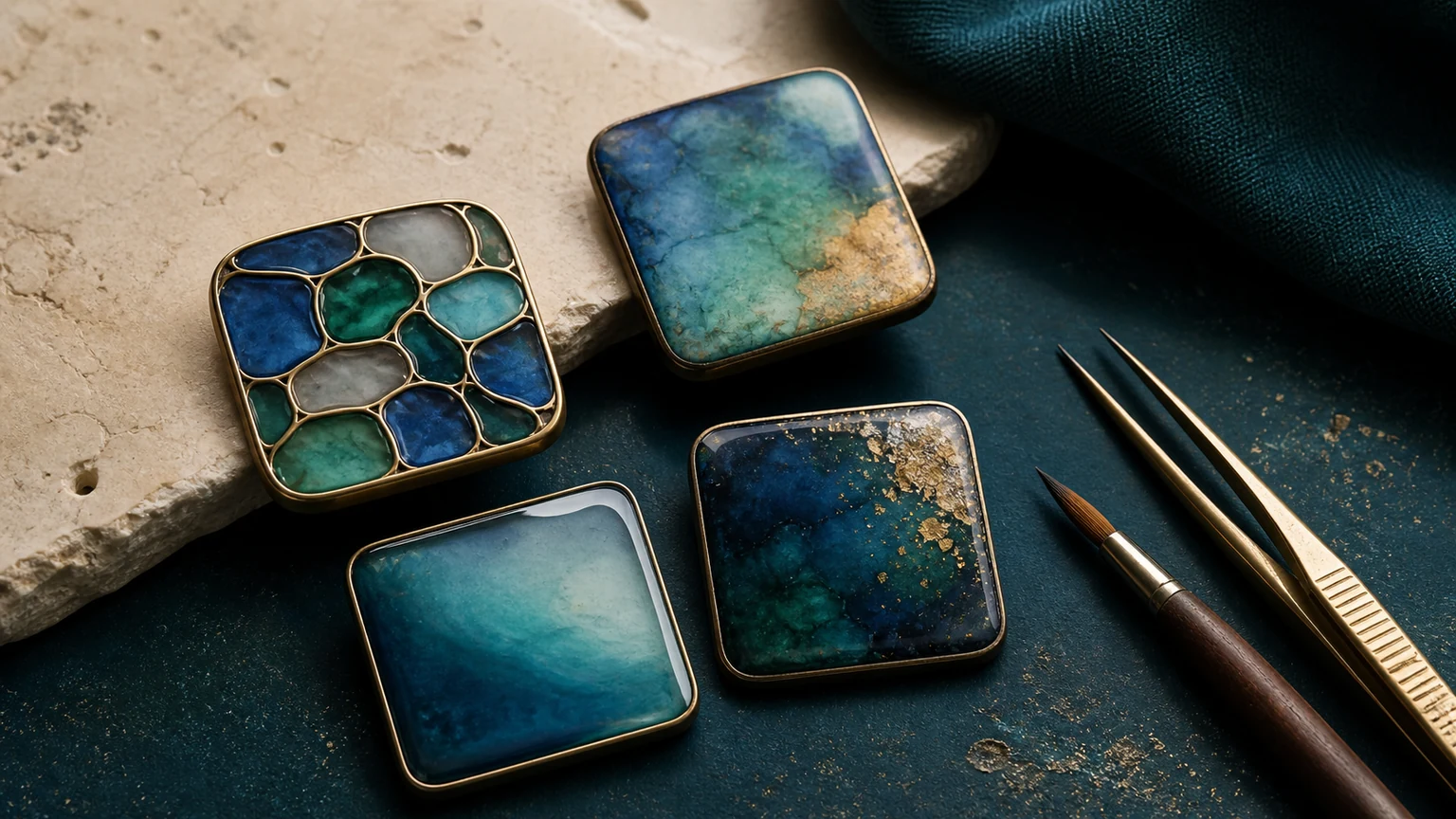
The V&A explains cloisonné as fine gold or silver wire fixed to a metal surface to form compartments into which colored enamels are fired. Visible lines are therefore structural, not merely painted outlines. A finished photograph may not reveal whether wire was soldered, cell shapes were cast, or decoration was applied over resin, so process documentation remains essential.
Vitreous enamel uses glassy material fused to metal through heat. The surface may be transparent, translucent, or opaque, and a piece can undergo repeated application, firing, grinding, and polishing. Hot enamel is common trade language, but a strong listing is more precise: vitreous enamel, base metal, workshop-reported firing process, and the number or sequence of stages.
The Government of Rajasthan describes meenakari through engraved recesses, sequential color application, individual firings, and final polishing. The Museum of Meenakari Heritage places painted enamel, champlevé, cloisonné, plique-à-jour, and Indian variants within a broader family. Meenakari and cloisonné may therefore overlap as cultural tradition and technical principle, but one word does not prove the other on a specific jewel.
Cold enamel is a trade term for a pigmented resin system. Flux Jewellery School demonstrates that accurate component ratios and setting conditions are central. Glass is not fused to metal in a kiln; a polymer hardens through chemical polymerization. This is not inherently a fake technique. It is a different material that should be named because its aging, scratching, and repair behavior differ.
| Term | Defining feature | Listing evidence |
|---|---|---|
| Cloisonné | Metal partitions form cells | Pre-fill image and maker process notes |
| Vitreous/hot enamel | Glass is fused to the base through firing | Composition, base, firing process |
| Meenakari | Documented Indian tradition and workshop practice | Place, workshop, stages, culturally reviewed terminology |
| Cold enamel | Pigmented resin sets without vitreous firing | Resin type, care instruction, repair limits |
Verifying the object and choosing appropriate care
Look for process images: clean metal blank, engraved recesses or wire cells, material application, kiln or curing stage, grinding, and the finished object. One generic bench image does not verify a product; the sequence must connect to the SKU or workshop. If confidentiality limits images, the seller can disclose stages in writing and name the source of the statement.
In macro views, inspect color boundaries, cell corners, metal edges, bubbles, chips, scratches, and possible shrinkage. Minor hand-process traces do not automatically mean poor quality, and a perfectly level surface does not prove machine production. Practical quality concerns are layer stability, no active lifting, safe edges, and consistency with the disclosed process.
Care follows the most sensitive component. For unknown enamel, use a dry soft cloth and avoid soaking, steam, ultrasonic cleaning, solvents, and abrasive polish. Vitreous enamel is hard but can chip from impact; resin can scratch, haze, or react with chemicals. Base metal and set stones create additional constraints.
Do not glue a lifting section with a household adhesive or fill a chip with clear polish. An incompatible repair complicates professional treatment and changes appearance. Photograph damage, stop wearing the piece, retain any detached fragment in a separate bag, and contact a maker who understands the original process. A listing should say whether repair is available without promising a service the shop does not provide.
Record a technique name at series or SKU level with the review date. If the workshop changes the colored material, firing schedule, or cell-forming method, an older description cannot move automatically to a new batch. A compact internal process card can list the base, color material, recess or partition method, firing or setting process, finishing, information source, and connected images without disclosing a proprietary formula.
Separate stable hand-process variation from active failure. Slightly uneven filling may remain sound, while a growing crack network, lifted edge, or moving fragment calls for stopping wear. Compare current macro views with the original under similar light. On a composite object, inspect metal, solder, and inserts as well, because repair of one layer can heat or chemically affect another.
When a listing uses two technique names, explain the relationship: one may identify a cultural tradition and the other a cell construction or material. A bare list can falsely imply that every process occurs in one piece. With insufficient records, use a neutral phrase such as “colored decorative layer” and ask the workshop for the process.
- Find the exact term, base, colored material, and documented process.
- Connect stage photography to the workshop or the product series.
- Inspect cells, boundaries, chips, lifting, and edges in macro views.
- Set care by the most sensitive component and begin with a dry cloth.
- After damage, stop wear and avoid household glue or abrasive treatment.
Questions and answers
- Are cloisonné and meenakari the same?
- No. Cloisonné describes metal-wire cells. Meenakari names an Indian enameling tradition that may use different technical approaches. A product needs process evidence.
- Is cold enamel worse than hot enamel?
- They are different materials, not a simple quality ladder. Resin and vitreous enamel offer different appearance, aging, repair, and care. Compare disclosed composition and workmanship.
- Can firing be identified by gloss?
- Not reliably. Polished resin can look glassy, while fired enamel can be matte. Workshop and process records are needed.
- How should an unknown enamel be cleaned?
- Use only a soft dry cloth and avoid liquid, solvent, ultrasonic, and abrasive methods until the materials are identified.
See current options and actual product photos in the Narayana Shop handmade collection. Accept an enamel-technique name only where the individual listing connects it to documented process evidence.
Continue reading
Sources and further reading
- Government of Rajasthan — official guide to the meenakari technique.
- Victoria and Albert Museum — metalworking and cloisonné techniques.
- Museum of Meenakari Heritage — materials, fire, and enameling techniques.
- Flux Jewellery School — cold enamel as a precisely mixed resin system.
This article explains techniques but does not attribute a product without process evidence. It promises no magical, medical, or protective effects and does not guarantee repair availability.