


Sterling Silver, Brass, and Copper: Patina, Skin Sensitivity, and Care
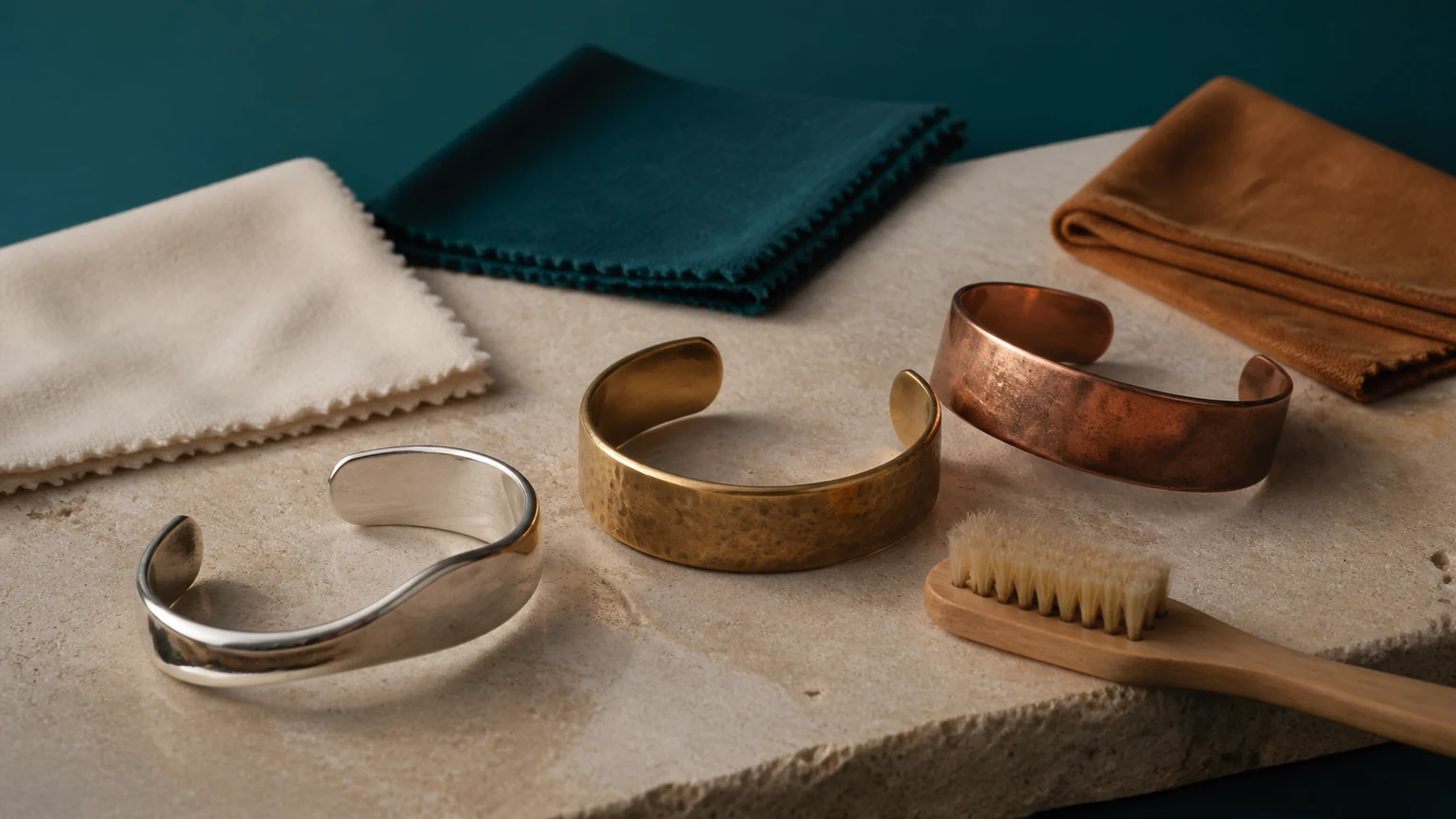
Sterling silver, brass, and copper age differently, yet each should be evaluated through the same three questions: what is the documented composition, is the surface change expected, and is the construction sound? A 925 mark refers to claimed silver fineness; it does not automatically establish origin, maker, or the composition of every component. Brass is a copper-zinc alloy, while copper may be a base metal or one part of another alloy. Stable patina can be an intended finish, but active corrosion, a failing joint, or a skin reaction calls for a pause and a more careful assessment.
What 925, brass, and copper actually tell you
Millesimal fineness expresses parts per thousand of a precious-metal alloy. Sterling silver at 925 therefore claims 925 parts silver per 1,000. A lone number stamped into a piece is not necessarily a complete government hallmark. UK guidance, for example, describes a hallmark built from a sponsor or maker mark, a fineness mark, and an assay-office mark, with weight exemptions. Other jurisdictions use different rules, so a UK standard cannot be projected onto every market and a photograph of “925” is not independent testing.
A useful listing identifies the base, plating, finish, and each part that touches skin. A pendant may be silver while its jump ring, pin, or chain uses another alloy. Gold plating, rhodium, lacquer, and deliberate oxidation also change care. If documentation covers only the pendant, precise copy says so; it should not silently extend the claim to the chain and findings.
Brass is a family of copper-zinc alloys with variable proportions and possible additions. Yellow color cannot establish the grade or the absence of nickel or lead. Uncoated copper often looks redder, but polishing, oxide films, lacquer, lighting, and editing alter appearance. A magnet, color comparison, or mark on a cloth cannot replace supplier specifications or suitable instrumental analysis.
Metals interact with moisture, salts, airborne contaminants, and contact materials. Silver commonly darkens in the presence of sulfur compounds; copper and brass can brown, darken, or develop green corrosion products. The Canadian Conservation Institute recommends understanding the environment and surface condition before treatment. An even, stable patina may belong to the design, while a powdery layer, pitting, cracks, or a moving joint merits professional attention.
Do not use “patina” to excuse every defect. Compare the received object with actual product photographs: are polished areas and dark recesses consistent, or is plating lifting at an edge? Look for burrs, fresh flakes, damp cord, and deposits near joints. Record the condition under neutral light. That simple baseline helps separate an intended finish from a change during storage or wear.
| Material or mark | Supported conclusion | Unsupported conclusion |
|---|---|---|
| 925 | The silver alloy is represented as 925/1000 | Official verification everywhere or that every component is silver |
| Brass | A copper-zinc alloy is claimed when documented | Exact grade, nickel-free status, or universal tolerance |
| Copper | Copper is listed as the material or base | Purity, origin, or coating safety without evidence |
| Dark patina | A natural or intentional surface film may be present | Every dark area is harmless or should be removed |
| Green transfer | Moisture, surface, and contact materials need review | A diagnosis or proof of a particular alloy |
Skin sensitivity and a conservative care sequence
A skin response may involve allergic contact dermatitis, friction, trapped cleanser, or several factors. Nickel is a common allergen, and the American Academy of Dermatology identifies jewelry as a frequent contact source. Location alone cannot identify the metal or establish a diagnosis. If itching, rash, weeping, pain, or swelling develops, remove the piece, gently clean the skin, and seek qualified care when symptoms persist; do not keep wearing it as a self-test.
Green or dark transfer is not synonymous with allergy. Copper-related surface compounds can move onto skin in the presence of moisture and cosmetics. Conversely, the absence of a mark does not prove that an alloy will suit a sensitive wearer. A sound decision depends on all skin-contact parts, plating, solders, and a clinician's advice for a known allergy—not on a broad “hypoallergenic” label.
Before cleaning, photograph the object, read its listing, and determine whether patina is intentional. Remove loose dust with a clean, dry, soft cloth. Toothpaste, baking soda, stiff brushes, and universal metal polish are poor defaults: abrasives remove material, scratch polished fields, wear plating, and erase darkened recesses. Immersion can also harm porous stones, adhesive, cord, wood, or enclosed cavities.
For silver, Canadian conservation guidance emphasizes tarnish prevention and restrained treatment rather than frequent aggressive polishing. If the construction permits a silver-care cloth, use it lightly on accessible plain metal and stop if plating transfers or intended contrast changes. A brass or copper polish belongs only on a confirmed bare alloy when a bright surface is the intended result. Lacquer, gilding, enamel, stones, and applied patina override any generic recipe.
After wear, use a dry cloth to remove moisture and cosmetic residue, allow the item to dry fully, and store pieces separately in a clean, stable place. Do not seal damp metal in a bag or let jewelry abrade against other objects. Periodically inspect clasps, pins, solder joints, holes, and settings. Metal loss, a fracture, a loose stone, or active lifting is repair work, not a polishing problem.
Conservative choices matter even more for an object with cultural, collectible, or personal value. Cleaning is irreversible: removed patina and tool traces cannot be restored with another wipe. Define the goal first—remove loose soil, brighten a daily-wear object, or preserve a historical surface. Those aims may conflict, and a trained conservator or jeweler should document higher-risk treatment.
- Verify the base, plating, clasp, pins, solder, and every skin-contact component.
- Distinguish an official hallmark from a simple mark and identify the governing jurisdiction.
- Record patina and damage under neutral light before cleaning.
- Start with a dry soft cloth; avoid abrasives, solutions, and immersion until compatibility is known.
- Stop wear after a skin reaction and seek medical evaluation for persistent symptoms.
- Choose repair instead of polish for loose construction, lifting finish, or active corrosion.
Questions and answers
- Does a 925 stamp prove that silver is genuine?
- No. It states claimed fineness. A complete hallmark, supporting records, jurisdiction, and sometimes professional testing determine how strongly that claim is verified.
- Should all patina be removed?
- No. Stable patina may be natural or intentional. Remove only established soil, and clarify the construction and desired result before polishing.
- Does a green mark from copper mean allergy?
- Not necessarily. It may be surface transfer, while persistent irritation still warrants stopping contact and obtaining medical advice.
- Can sterling silver be cleaned with toothpaste?
- It should not be the default. Toothpaste is abrasive and may scratch metal, wear plating, or erase deliberate contrast. Use a method approved for the particular construction.
See current options and actual product photos in the Narayana Shop handmade collection. Check the individual listing for the metal, finish, and skin-contact components before choosing.
Continue reading
Sources and further reading
- UK Government — Hallmarking guidance summary.
- Canadian Conservation Institute — Guidelines for metal objects.
- Canadian Conservation Institute — Care of silver.
- American Academy of Dermatology — Nickel allergy and jewelry.
This educational article does not diagnose a skin response, replace medical or conservation advice, or verify the composition of a particular product without documentation.