

Amethyst, Rose Quartz, and Clear Quartz: Visual Clues and Gentle Care
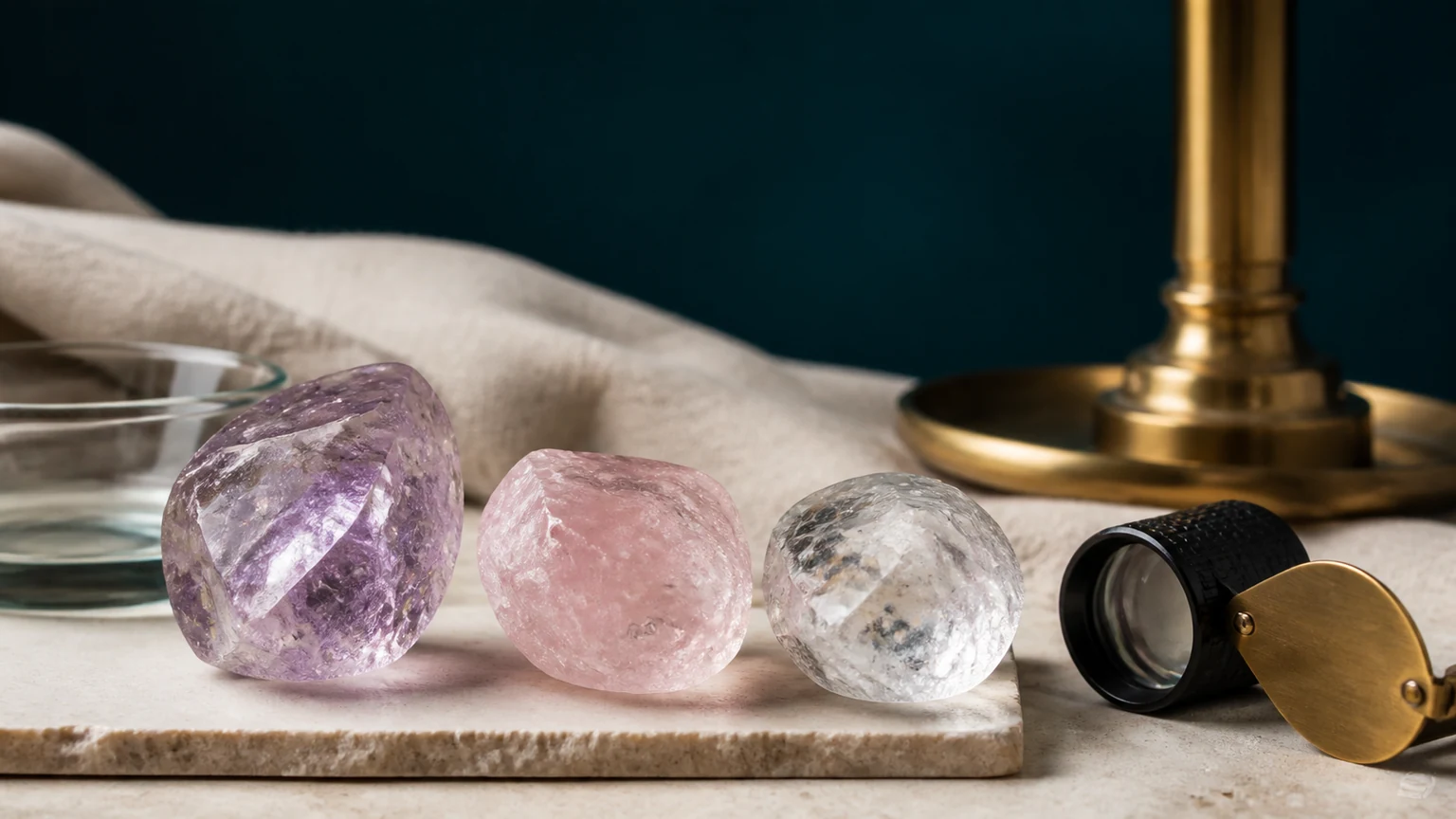
Amethyst, rose quartz, and rock crystal are quartz varieties distinguished primarily by optical appearance: purple, pink, and colorless. Transparency, zoning, and inclusions vary widely, while glass, synthetic quartz, and treated materials can look similar. A purchase requires a supported material name and treatment disclosure. Care must account for the entire piece—not only the mineral’s hardness.
Reading color, transparency, and internal features
GIA identifies amethyst as the purple variety of quartz and calls colorless quartz rock crystal. Amethyst ranges from pale lilac to saturated purple and can show visible zoning. A zone changes as a bead turns. This is a valid observation, but color intensity alone does not establish origin, quality, or the absence of heat treatment.
Rose quartz has a soft pink body color and is commonly translucent because of microscopic features. GIA notes that it is occasionally irradiated to intensify color. A buyer cannot establish that history from one image. Look for seller disclosure, consistent color across views, and documentation when treatment is material to the decision.
Rock crystal may be water-clear or contain clouds, needles, healed fractures, and growth zones. A bubble does not conclusively prove glass, and an inclusion-free appearance does not prove synthetic quartz. A preliminary inspection turns the bead under neutral and transmitted light to observe edges, surface scratches, internal features, and the drill channel. Identification still requires gemological methods.
Compare all three materials against white, neutral gray, and black matte grounds. White reveals overall color, gray helps control balance, and black defines the edge of a transparent bead. Keep exposure constant rather than lighting one sample more strongly. An actual-bracelet listing should show the overall strand and macros of its palest, darkest, and most included beads.
| Material | Useful visual description | Necessary limit |
|---|---|---|
| Amethyst | Purple hue, zoning, transparency | Color does not prove origin or treatment |
| Rose quartz | Pink hue, cloudiness, inclusions | Even color does not prove natural status |
| Rock crystal | Colorlessness, transparency, internal features | A photo cannot exclude glass or synthetic quartz |
| Any of the three | Chips, hole fractures, surface condition | Hardness does not mean indestructibility |
Gentle cleaning, drying, and storage
GIA lists warm soapy water as a safe cleaning method for amethyst and rose quartz, but a piece contains more than one mineral. Elastic, knots, adhesive, tassels, plating, or enamel may need a drier method. Begin by removing dust with a soft lint-free cloth, then follow the item-specific care instruction.
When wet cleaning is approved, use a small bowl of warm—not hot—water with a drop of mild, nonabrasive soap. Do not soak the jewelry. Wipe accessible surfaces gently with a cloth or very soft brush, avoiding pressure at drill holes. Rinse briefly, blot, and finish air-drying the piece flat at room temperature.
A general home guide should avoid steam and ultrasonic cleaning. GIA does not recommend steam for amethyst and lists exceptions to ultrasonic use for dyed or fracture-filled material; it advises against both ultrasonic and steam for rose quartz. If treatment history is unknown or adhesive is present, hand cleaning or professional assessment is the safer route.
Store pieces separately so harder edges cannot scratch softer neighboring materials and metal findings cannot strike the beads. Keep amethyst away from prolonged intense light because GIA notes possible fading in some material. A dry, closed box with soft dividers is preferable to a windowsill, bathroom, or vehicle with rapid temperature changes.
Treat the setting, cord, and adhesive as part of the care decision. A method suitable for a loose quartz specimen may harm plating, enamel, or a joint. Inspect holes and the back before wet cleaning, then dry at room conditions without a hair dryer, radiator, or direct sun. Sudden heat and temperature change are poor defaults even when the mineral itself seems hard.
Transmitted-light images can document transparency and internal features, but should not replace ordinary reflected-light views. Label both. Do not selectively intensify amethyst purple or rose-quartz pink, and place clear quartz against a background that preserves both outline and unretouched inclusions.
After an impact, compare any new line with the original macro and stop loading the piece. A phone image may not separate a scratch, inclusion, and developing fracture. Do not perform a sharp scratch or heat test. Retain a detached part and seek a jeweler or gemologist when safe wear or significant value depends on the assessment.
Store pieces behind soft dividers. Quartz can scratch softer materials and can itself chip from impact; close hardware so that metal does not strike the beads when the box moves.
- Confirm every component and any disclosed treatment.
- Photograph the piece before cleaning and mark fractures near drill holes.
- Begin dry; use water only when the full construction is compatible.
- Avoid steam, ultrasonic cleaning, abrasives, and abrupt heat when history is unknown.
- Dry completely and store apart from harder or sharp jewelry.
Questions and answers
- Can amethyst fade in sunlight?
- GIA notes that some amethyst may fade after prolonged exposure to intense light. Storage away from constant bright light is prudent.
- Can bubbles distinguish rock crystal from glass?
- Not reliably as a single clue. Internal features need context and further testing. A consequential identification requires gemological examination.
- Is an ultrasonic cleaner safe?
- It is not a universal home recommendation. Treatment, fractures, adhesive, and other components can make ultrasonic cleaning risky.
- Why do rose quartz beads vary in transparency?
- Natural structure, thickness, inclusions, and orientation affect appearance. The listing should show the actual range and disclose known treatments.
See current options and actual quartz-product photos in the Narayana Shop handmade bracelet collection. Verify material, treatment, and construction on the individual listing.
Continue reading
Sources and further reading
- GIA — amethyst hardness, stability, and cleaning.
- GIA — rose quartz care, stability, and possible treatment.
- GIA — amethyst as a quartz variety and rock crystal.
- GIA — Gem Encyclopedia.
This guide does not replace gemological identification. Care applies only after every component is checked, and no medical or metaphysical outcome is claimed.