

Caring for Tulsi Beads: Water, Oils, Humidity, and Storage
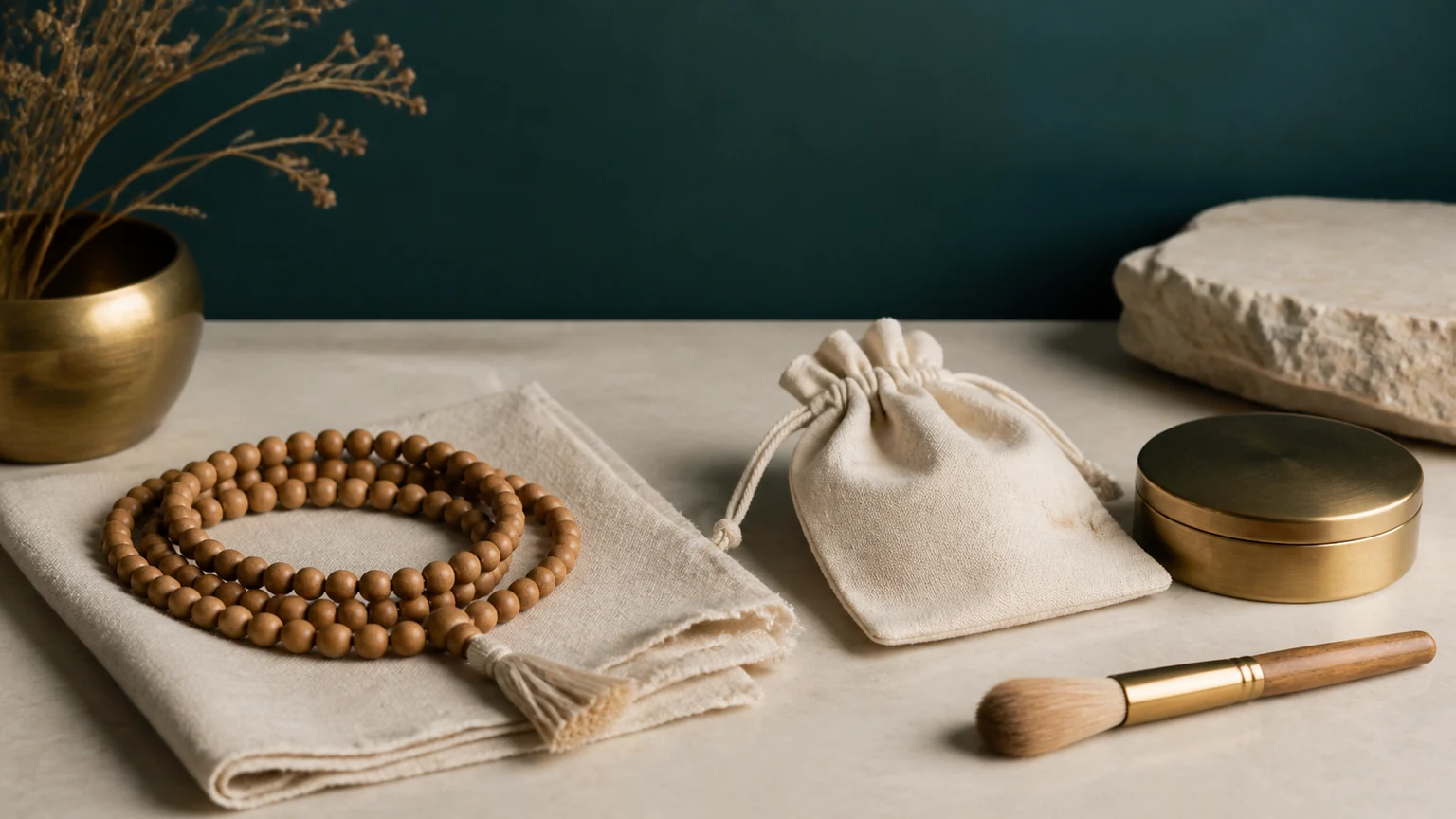
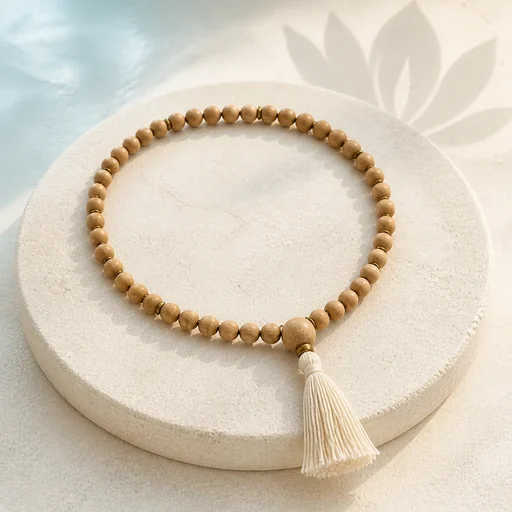
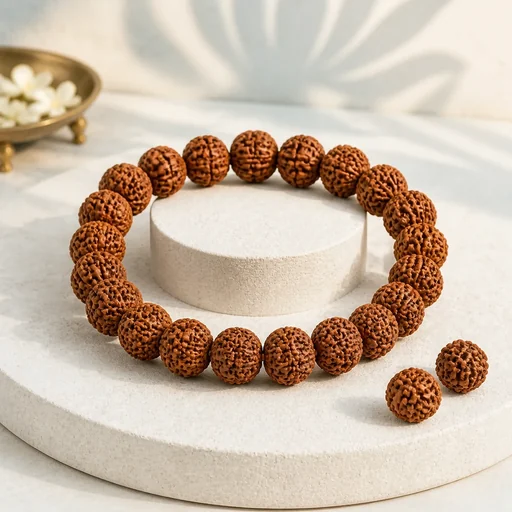
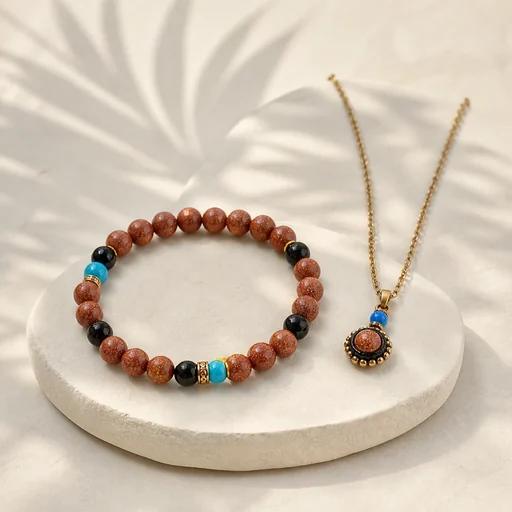
Caring for Tulsi beads primarily means protecting the wood and its stringing system from prolonged wetting, cosmetic oils, abrupt humidity changes, and damp closed storage. The safest routine is dry inspection, gentle dust removal, room-temperature drying after accidental water, and a separate breathable container.
Water, oils, and humidity around Tulsi beads
Wood is hygroscopic: it exchanges moisture with surrounding air. National Park Service guidance explains that changes in relative humidity drive moisture exchange, expansion, and contraction in wood; repeated or abrupt changes can contribute to cracks and distortion. A small bead responds faster than furniture, while the channel, knot, and contact surfaces complicate drying.
A few droplets do not mean the piece is lost. Risk increases with soaking, hot water, detergents, hard rubbing, and forced heat afterward. If a kanthi mala becomes wet, remove it without pulling, blot with a clean absorbent cloth, and lay it loosely in a ventilated room. Do not seal it damp or place it on a radiator.
Applied oils are a separate decision. Ordinary wear already transfers some skin oil; that is not the same as saturating the wood. Cosmetic or plant oils may darken the bead, retain dust, soften a finish, or affect fiber and adhesive. “Oil all wood” is too broad. Use only a product-specific instruction that names the material and finish.
Apply fragrance, hair product, moisturizer, or sunscreen before putting the strand on and let the skin surface dry. This reduces soil; it is not a judgment about the cosmetic. If a product reaches the beads, do not try to neutralize it with another chemical. Record the area and ask the maker.
A humid bathroom or sealed gym bag differs from direct rain: the piece remains in moist air beside fabric holding water and perspiration. Very dry air at a heater is another extreme. The sensible household strategy is not to chase one perfect number but to avoid extremes and rapid transitions.
A practical after-wear and accidental-water protocol
A routine should be simple enough to follow. A kanthi mala does not require aggressive cleaning after every short wear. More important is clean handling, a quick cord check, and full evaporation before storage. If your community expects continuous wear, discuss how to reconcile observance with material preservation with a relevant teacher and maker.
| Situation | First action | Then check |
|---|---|---|
| Ordinary dry wear | Lay relaxed and remove loose dust with a dry cloth | Knots, channel edges, and length change |
| A few water drops | Blot without rubbing and provide air | Complete drying between beads and junctions |
| Heavy wetting | Support the whole loop on cloth and air-dry | Core stretch, odor, dye transfer, or cracks |
| Cosmetic contact | Lift excess with a clean dry cloth | Maker guidance before any solvent |
| Long storage | Use a clean, dry pouch or supported box | Occasional checks for dust, damp, and pests |
- Work over a tray or light cloth so loose beads cannot disappear.
- Support several parts of the core rather than lifting one bead.
- Move a soft dry brush with the finished surface, never against it forcefully.
- Dry completely after water before putting the item away.
- Do not add oil, wax, or household cleaner without compatible instructions.
- Photograph new damage and stop wearing the strand when breakage is possible.
Store the piece away from heavy jewelry, sharp closures, and fabrics that may transfer color. A small supported box or relaxed pouch prevents severe bends. Arrange multiple rows in parallel rather than tying them together. Keep the care note nearby without allowing paper edges to catch the beads.
For travel, use a small rigid case and never pack the item while damp. After a sharp temperature change, allow a closed case to approach room temperature before opening when condensation is possible, particularly after winter outdoor exposure or cool transport.
If color deepens over time, it may reflect contact, skin oil, light, or an earlier finish. Do not automatically call every change a desirable patina. Document it and compare it with product guidance. Care should preserve strength and a clear object history rather than force a target shade.
Questions and answers
- Can I shower in a kanthi mala?
- Regular wetting affects both wood and cord. If continuous wear matters in your tradition, ask a teacher about observance and the maker about the actual construction.
- Which oil is best for Tulsi?
- There is no universal oil. Without item guidance, applying nothing is safer because a product may change color, finish, or core.
- Should I add a silica-gel packet?
- Ordinary dry, stable storage is usually sufficient. An uncontrolled desiccant in a tiny sealed box can create an overly dry microclimate.
- What should I do with a cracked bead?
- Stop tension, photograph the area, and consult a maker. Ask your community separately about religious handling of the object.
See current options and actual product photos in the Narayana Shop kanthi mala collection. Check core material and item-specific care guidance before treatment.
Continue reading
Sources and further reading
- NCBI Taxonomy — Ocimum tenuiflorum taxonomic record.
- U.S. National Park Service — Curatorial Care of Wooden Objects.
This is preventive guidance. Follow verified instructions for the individual item and seek skilled repair for damage or an unidentified finish.