




Tulsi Bead Shapes and Sizes: Round, Barrel, Strand Length, and Fit
Tulsi bead size should be described with at least two dimensions—width and length—because a round bead and a barrel shape occupy strand space differently and feel different in wear. Finished inside circumference, spacing, knots, and the actual range of natural bead sizes also determine fit.
Round, barrel, and other shapes: what to measure
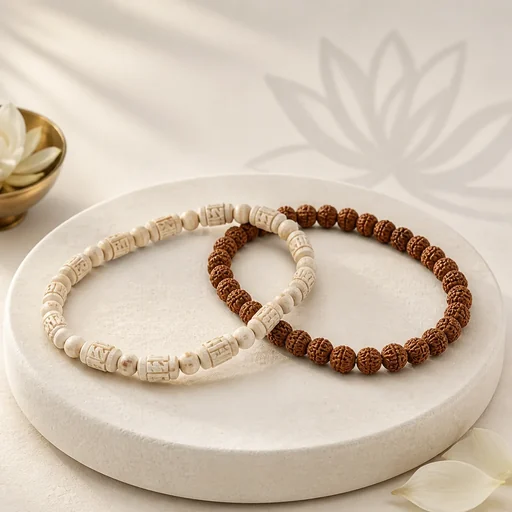
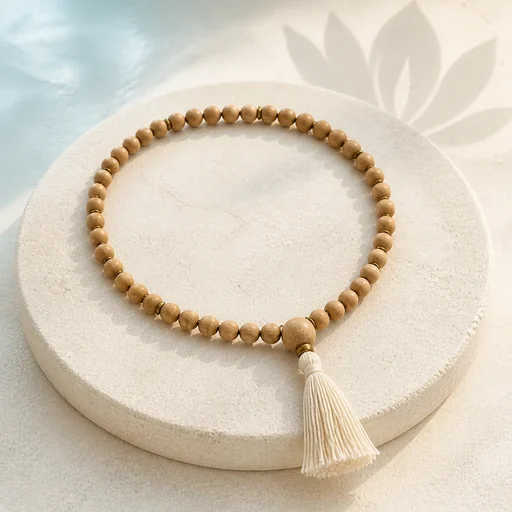
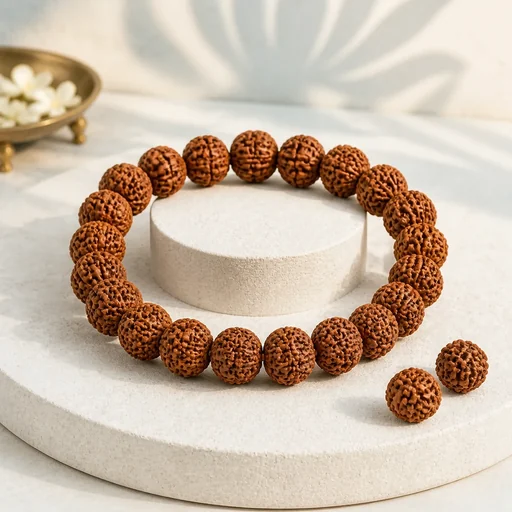
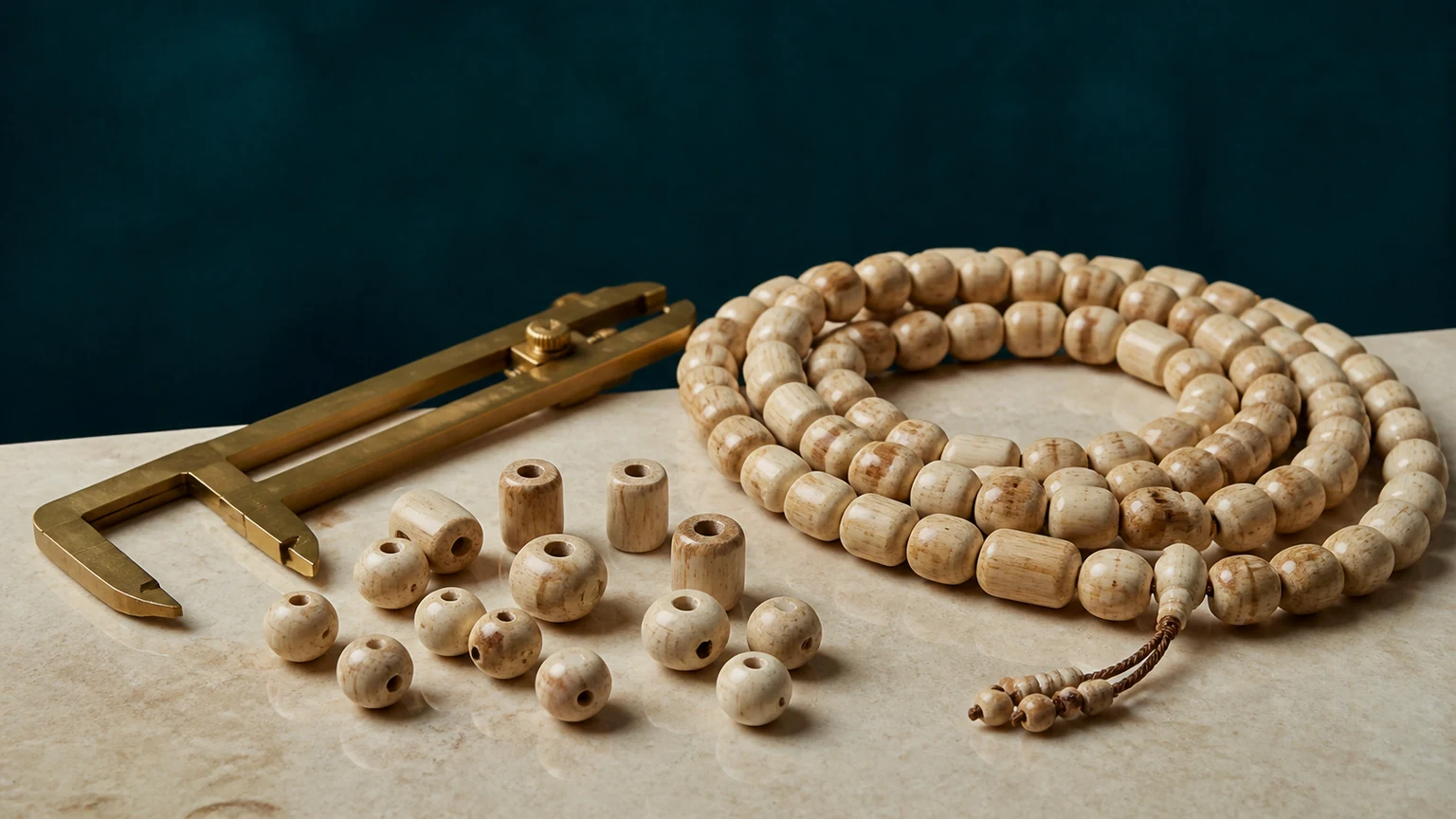
A round bead has broadly similar width and length, although plant material rarely forms a perfect sphere. “Rounded” plus a measurement across the widest point is often the most honest description. When axes differ noticeably, provide both: width across the channel and length along it.
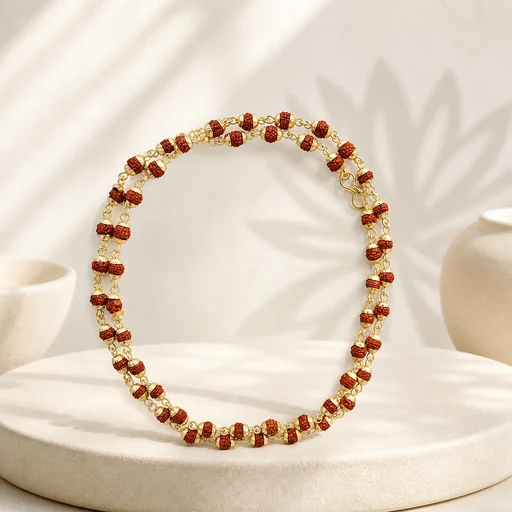
A barrel bead is generally elongated along the cord, fuller at the middle, and tapered toward the ends. It may be gently oval, cylindrical, or faceted through hand finishing. One number such as “6 mm” does not reveal which dimension was measured. Width × length plus a macro view beside a millimeter scale communicates proportion.
Disc, tube, and transitional shapes also appear, with maker terminology varying. A separate search category for every silhouette is unnecessary. Describe the visible geometry, hole direction, and measured range rather than promising strict standardization in a botanical material.
NCBI confirms the scientific identity of Ocimum tenuiflorum and the common name holy basil. Plant material has directional fibers and natural thickness variation. Those general facts explain possible variation but do not identify the material of a particular strand; maker or supplier evidence is still required.
Measure the opening separately when repair compatibility matters. Cord thickness does not reliably reveal channel diameter because multiple fibers, knots, or empty space may be inside. A sharp entry edge can affect core wear more than a small difference in exterior size.
How to measure beads, strand length, and fit
A millimeter ruler is adequate for basic home measurements; NIST publishes its Metric Ruler as an educational tool for measuring small objects. Calipers offer finer readings, but their jaws should never compress a delicate bead. Record only sensible precision: an ordinary ruler does not justify hundredths of a millimeter.
- Lay the piece relaxed. Do not stretch elastic or force knots straight.
- Sample several beads. Measure smaller, middle, and larger examples.
- Record two axes. For elongated shapes, give width and channel-axis length.
- Report a range. Publish minimum and maximum rather than a convenient average alone.
- Measure the finished loop. State full inside circumference or twice the folded length.
- Photograph the scale. Keep ruler and beads in one plane to reduce perspective error.
| Feature | Record | Why it matters |
|---|---|---|
| Rounded bead | Diameter or two axes when irregular | Supports a consistent tactile comparison |
| Barrel bead | Maximum width and length along the strand | May occupy more strand length at moderate thickness |
| Channel | Diameter when available, edge condition, number of cores | Affects repair and abrasion |
| Loop | Measurement method and unstretched inside length | Helps model placement |
| Weight | Finished-piece mass when measured | Adds context for multi-row comparisons |
Model the inside length with a soft tape. A flat tape is thinner than beads, and multiple rows occupy more space, so preserve movement allowance. Check the position with the type of collar you normally wear. A tight loop is not a valid shortcut to a supposedly correct size.
A photograph on a person helps only when accompanied by measurements. Camera angle, clothing, and retouching alter placement. A neutral display form with scale gives context but cannot replace an individual fit check.
If the strand is size-graded, the listing should explain whether the beads are uniform, graduated, or intentionally mixed. Each approach can be visually coherent, but none is spiritually superior. Inspect whether abrupt transitions create rubbing or conceal adjacent knots.
On receipt, repeat a few measurements on the dry piece before altering it. Small differences may result from method and irregular geometry; a substantial discrepancy deserves clarification. Preserve the tag and original-layout photographs if restringing is planned.
Questions and answers
- What Tulsi bead size is most comfortable?
- There is no universal answer. Compare thickness, axial length, channel edges, weight, and intended placement using actual measurements.
- Why list a size range?
- Natural beads differ. A range is more honest than a rounded single figure when it comes from the actual strand.
- Should elastic be measured while stretched?
- Not for ordinary finished length. Record the relaxed size; stretch behavior is a separate construction characteristic.
- Are barrel beads always larger than round beads?
- No. Barrel describes proportion, not absolute scale. Compare width and length in millimeters.
See current options and actual product photos in the Narayana Shop kanthi mala collection. Match dimensions to the actual strand and stated measurement method.
Continue reading
Sources and further reading
- NCBI Taxonomy — Ocimum tenuiflorum taxonomic record.
- National Institute of Standards and Technology — Metric Ruler SP 376 for small-object measurement.
- U.S. National Park Service — Curatorial Care of Ceramic, Glass, and Stone Objects.
Measurements support comparison, but comfort is individual. Do not stretch or dismantle a piece solely to measure it.