

How to Compare Karatals Online: Diameter, Metal, Weight, and an Honest Sound Sample
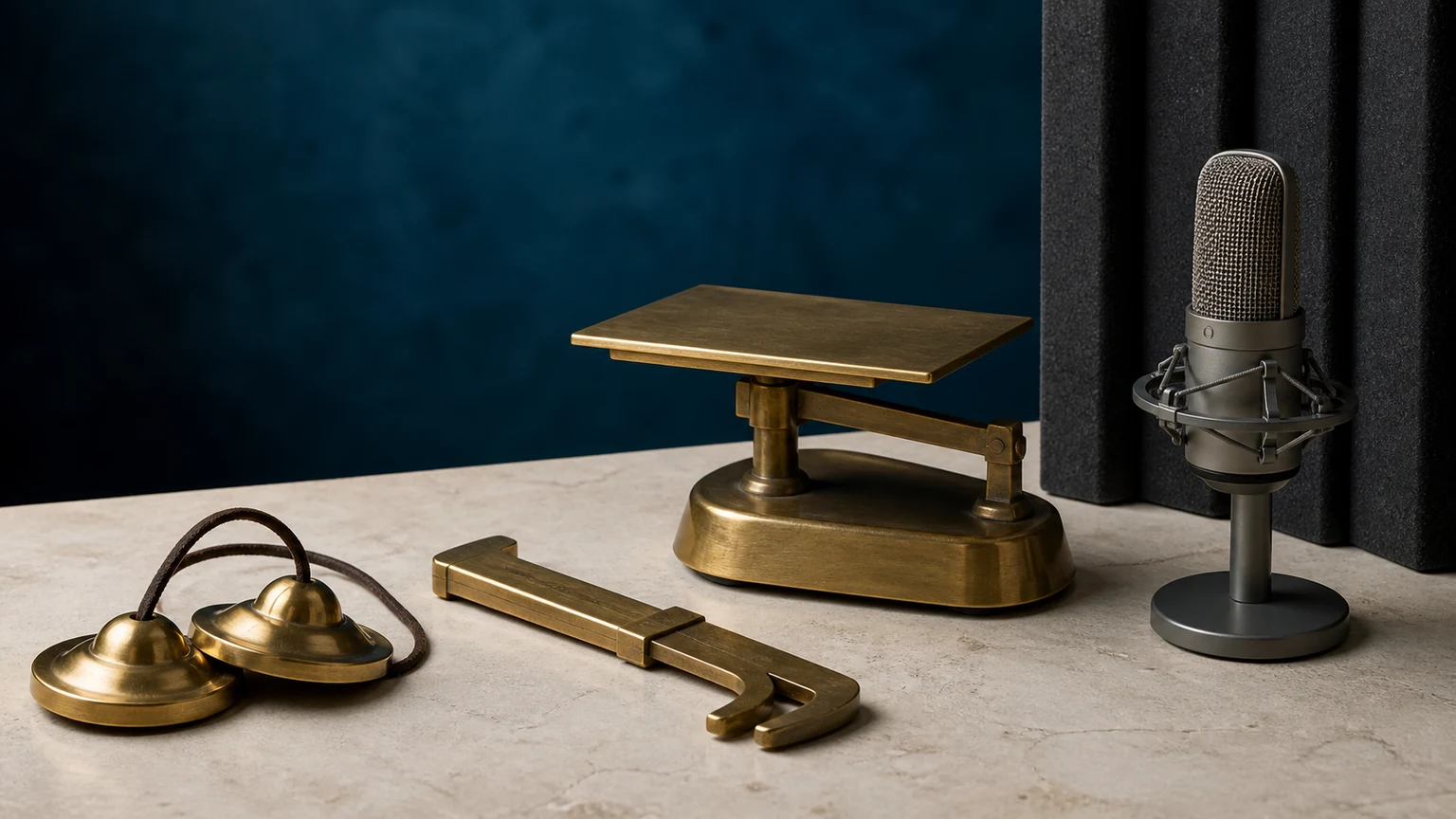
How can you compare karatals online when two bright circles look nearly identical in a product photo? Build a record for the exact pair: diameter and mass of each cymbal, total pair mass, rim thickness, dome profile, maker-documented material, cord, and condition. Audio helps only when it captures that same pair and discloses room, microphone, distance, angle, gain, playing gesture, and processing. A polished clip cannot represent every pair in a model, and no measured frequency establishes a healing, therapeutic, or guaranteed spiritual effect.
A record for the exact pair
Assign an internal number to the pair and include it in photographs with ruler and scale. Measure each cymbal across its widest outer diameter through the center and report millimeters. Weigh left, right, and the assembled pair with cord, noting scale resolution and a zero check. The figures describe size, balance, and likely hand load; they are not a quality ranking or a universal comfort rating.
Dome profile, rim thickness, interior cavity, relief, casting, and finishing all contribute to mechanical response. The UNSW primer on bells and plates explains that such objects vibrate in multiple modes rather than producing one magical frequency. Two pairs with the same nominal diameter may sound different because the complete geometry differs. Provide profile and interior photos rather than asking diameter alone to predict pitch or decay.
Do not infer alloy from yellow, silver, or dark color. Use a maker or supplier record for the batch, and connect claims such as brass, bronze, or a percentage composition to that document. Country, city, workshop, and handmade production also need evidence for the actual lot. If exact alloy or provenance is unavailable, identify the information as unavailable instead of completing it from appearance or another product.
Inspect cord, holes, rims, and both inner faces for cracks, burrs, deep pits, or deformation. Photos should show both cymbals inside and out under neutral light. Condition is part of a sound comparison: a loose knot, soft cord, or burr changes handling and may require correction before recording. The listed pair should remain identifiable and in stock after the sample is made.
| Field | How to document it | Do not infer |
|---|---|---|
| Diameter | Each cymbal through center, in millimeters | Exact pitch or universal comfort |
| Mass | Left, right, and assembled pair with scale resolution | Quality, loudness, or endurance without testing |
| Material | Batch-specific maker or supplier record | Alloy, percentage, or region from color |
| Audio | Same pair, room, microphone, distance, gain, and processing | Sound of another pair or undisclosed enhancement |
An honest sound sample
Record the numbered in-stock pair. Keep performer location, microphone height, distance, and angle fixed. Document room, microphone, recorder, sample rate, bit depth, gain, and peak level. Include brief room tone, single soft and medium strikes, and one short standardized phrase. This creates useful comparison while acknowledging that performance technique remains a variable.
Publish an unprocessed file or a version trimmed only at its boundaries. If you add a loudness-matched comparison, disclose the algorithm, target, and peak constraint. ITU-R BS.1770 and EBU R 128 provide established language for loudness measurement. Do not hide equalization, compression, noise reduction, reverberation, sample replacement, or normalization; each can make a pair seem brighter, longer, cleaner, or louder than the raw capture.
Room, microphone, codec, speakers, and headphones color playback, so a recording cannot promise identical sound at home. It can compare attack, decay, rattles, and general character under one protocol. Descriptions such as bright, dark, dry, or sustained remain editorial observations rather than physical guarantees. Offer the same file format and level treatment across compared pairs.
Karatals belong to living musical and devotional settings in which technique, rhythm, ensemble balance, and etiquette vary. A shop clip is not instruction in one correct method. Seek a qualified teacher within the relevant tradition for playing practice. Timbre, spectra, or rhythm also do not justify claims of bodily harmonization, treatment, cleansing, or guaranteed spiritual experience.
- Assign one pair ID and show it in measurement photos and audio notes.
- Measure each cymbal's diameter and mass plus the assembled pair.
- Support alloy and provenance with batch documentation or mark them unknown.
- Record the same pair with a fixed protocol and disclose every processing step.
- Compare observable sound without therapeutic or guaranteed spiritual claims.
Questions and answers
- Can sound be predicted from diameter?
- No. Diameter matters, but profile, thickness, alloy, finish, and strike also shape the response. Listen to the exact pair.
- Should total pair weight or individual weight be listed?
- Both. Total weight describes hand load, while separate figures reveal the balance of that specific pair.
- Why will the sample sound different at home?
- Room, microphone, processing, codec, speakers, and headphones color the result. The sample is comparative, not a promise of identical playback.
- Do karatals have a healing frequency?
- This article provides no basis for that claim. A complex spectrum does not establish treatment, healing, or a guaranteed spiritual outcome.
Compare documented dimensions, materials, and available sound samples in the Narayana Shop musical instruments collection. Confirm that photos, measurements, and audio refer to the same pair.
Continue reading
Sources and further reading
- University of New South Wales — acoustics of bells and plates.
- ITU-R BS.1770 — algorithms for audio programme loudness.
- European Broadcasting Union — Loudness Recommendation R 128.
- National Institute of Standards and Technology — SI units for length.
A sound sample depends on the pair, performer, room, microphone, processing, and playback system. This article makes no healing, therapeutic, or guaranteed spiritual claim.