


Japa Counters: Counter Strands, Markers, and Multiple Rounds
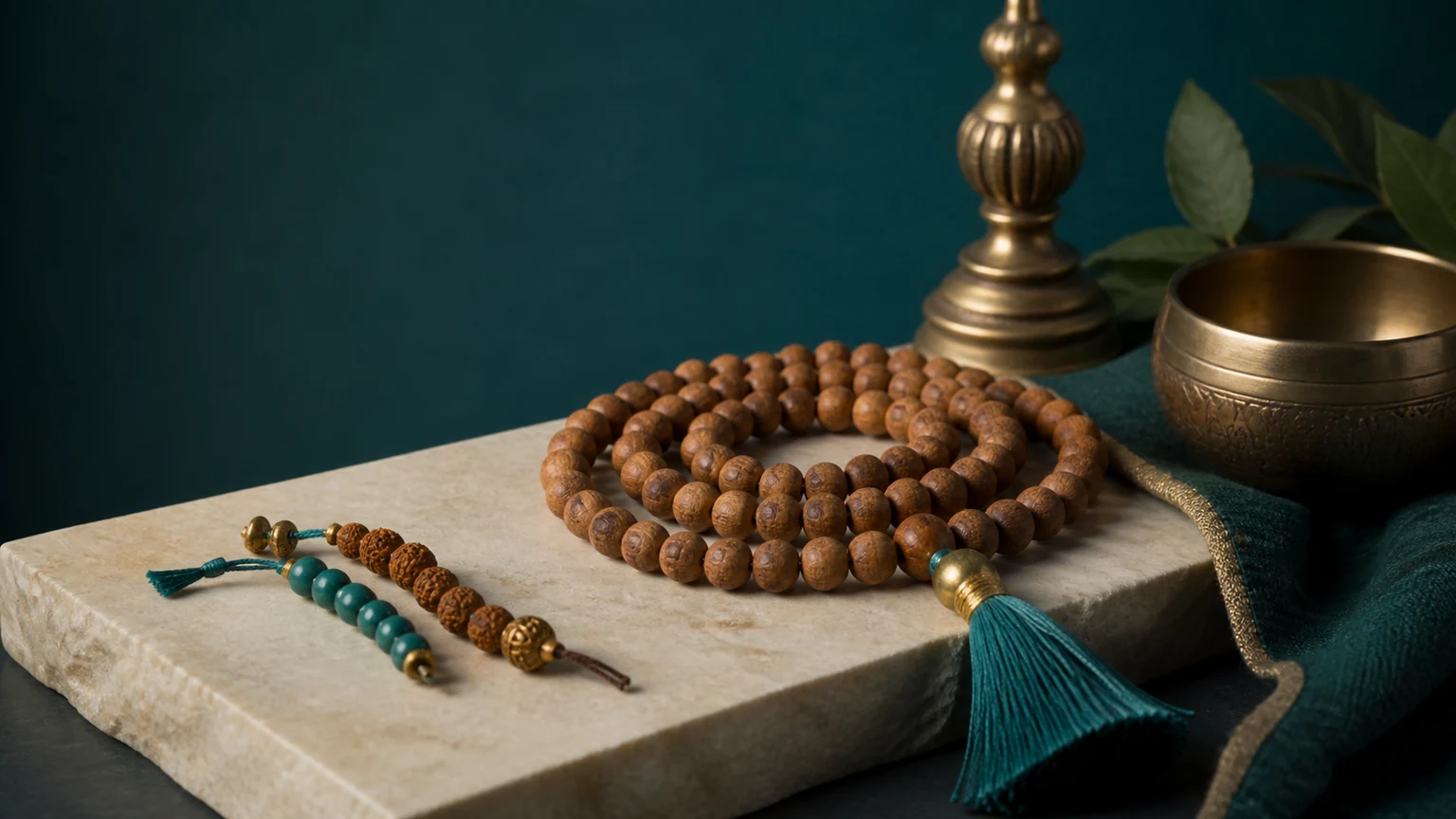
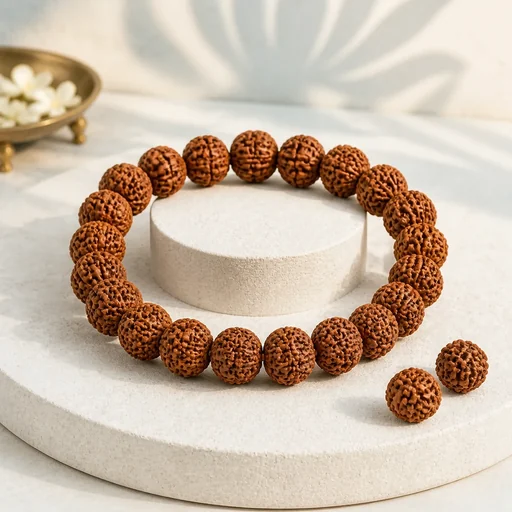
Japa counters do not replace the main mala. They record completed rounds or larger groups after the working beads have counted individual repetitions. In the Gaudiya Vaishnava method described below, one full circuit of the working beads is a round, while a separate short strand keeps that total out of working memory. The object is simple, but its use is tradition-specific, so a good product description must explain the counting logic rather than assume a universal rule.
What the mala counts and what the counter records
Separate three levels before choosing a counter. The first is one recitation of a mantra or prayer formula. The second is one circuit of the main mala’s working beads. The third is a series of circuits. A finger advances bead by bead on the main strand; a short counter marks a circuit only after it is complete. If those levels are blurred, the words bead, repetition, and round can mean different things to the seller and the practitioner.
Krishna.com gives a specific Gaudiya Vaishnava instruction: the working strand has 108 beads plus a head bead; returning to the head bead completes a round, the practitioner does not chant on that bead, and the strand is turned for the next circuit. The same page explicitly says that a string of counter beads attached to a bead bag can track rounds by moving one counter bead after each completed circuit. This is strong primary guidance for that community, not a basis for imposing the same procedure on Buddhist, Shaiva, or secular counting strands.
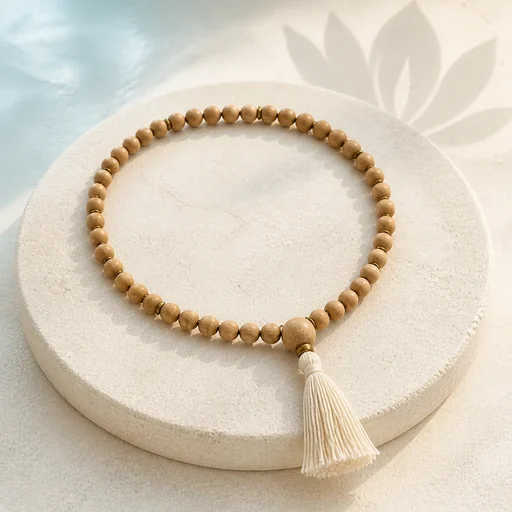
A counter may be a short cord with several movable beads, two groups that represent units and larger sets, or separate markers. A model name does not reveal its arithmetic. Look for a diagram explaining how many stable positions each section has, which way a marker moves, and what happens after all positions are used. If no diagram is published, the seller should be able to explain the system plainly and demonstrate the actual item.
Museum records support the broader cultural presence of japa malas but are not modern operating manuals. The British Museum, for example, catalogs a Kalighat painting of Chaitanya holding a meditation garland. That record helps establish visual and historical context; the exact method of counting should still come from a primary guide representing the relevant living practice.
| Element | Practical role | Listing detail to verify |
|---|---|---|
| Main mala | Counts repetitions in one circuit | Working-bead count, head bead, direction |
| Short counter strand | Records completed rounds | Number of markers and holding friction |
| Second marker group | Tracks a larger set | Carry and reset rule |
| Stop or separator | Limits accidental movement | Material, friction, smooth edges |
| Bag loop or attachment | Stores or anchors the counter in a named practice | Stitching, dimensions, attachment point |
How to select and test a japa counter
Start with tactile logic, not ornament. Move every marker once with clean, dry hands. It should respond to deliberate pressure and remain where placed when the strand hangs normally. A very tight stop can interrupt use and abrade the cord; a loose one can erase the record. Because useful friction depends on the cord and hole diameters, a short demonstration of the actual construction is more informative than a generic claim that it is firmly attached.
Next, run a dry rehearsal without reciting. Assign temporary values, simulate several rounds, pause, place the set in its normal storage location, and check whether the position remains legible. This evaluates mechanics, not spiritual performance. If the counter attaches to a bead bag, confirm that the loop cannot entangle the working mala and that cord ends or bead edges do not snag the fabric.
A two-level counter needs a written legend. One group may represent units and another completed blocks, but the values must come from the practice being followed. Photograph the starting position or keep a small diagram with the set. This matters when people bring different habits to a similar object: the physical strand may be identical while their assumed arithmetic is not.
Inspect knots, hole edges, and the attachment point periodically. Fuzzing, stretching, a fresh bead crack, or a sudden change in friction is a reason to pause and replace a worn component. Do not oil the cord or tighten an unfamiliar knot by guesswork. Oil can change friction and stain a bag, while extra tension may speed wear. Care advice should always match the documented materials of the specific counter.
Plan how a session ends. If a circuit is interrupted, record whether it remains incomplete or is handled under a rule from your practice; the counter itself cannot decide. After the final full round, verify marker positions and return the strand to the agreed starting state when appropriate. Avoid leaving an ambiguous pattern to reconstruct later. This closing protocol reduces arithmetic errors without treating a numeric target as evidence of prayer quality, concentration, or spiritual attainment.
- Define one repetition, one round, and one larger set in writing.
- Match the working-bead count and head-bead convention to a source from your tradition.
- Test every marker for deliberate movement, stable holding, and smooth edges.
- Run a dry pause-and-carry test without treating it as evidence of an outcome.
- Save the reset diagram and inspect the cord regularly.
Questions and answers
- Do I need a separate counter for a single round?
- Usually the main mala already counts repetitions within that circuit. A separate strand becomes useful for several completed rounds or larger groups. Follow the arithmetic documented for your practice.
- How many beads should a counter strand have?
- There is no universal number. The essential information is its range, carry rule, and reset position. Without those details, even a well-made strand remains ambiguous.
- Can an app replace a counter strand?
- It can perform the arithmetic if that is appropriate in your setting. A phone, clicker, and cord provide different tactile experiences. Ask a qualified representative of your tradition about religious suitability.
- How can I tell whether a marker is too loose?
- Set a position, carry the strand gently, and inspect it again. If the bead moves without deliberate pressure, it is not preserving the record reliably and should be adjusted or replaced.
See current options and actual product photos in the Narayana Shop mala and prayer-bead collection. Verify the bead count, construction, and intended use on the individual listing, and use a practice source for religious conventions.
Continue reading
Sources and further reading
- Krishna.com — “How to Chant on Beads”.
- Vedabase — Chant and Be Happy, chapter 10: japa and one round.
- British Museum — painting of Chaitanya holding a japa mala.
This educational guide describes verifiable counting mechanics. It does not establish universal religious rules or promise spiritual, psychological, or physical outcomes.