







Anatomy of a Mala: Guru Bead, Meru, Bindu, Markers, and Tassel

Mala anatomy is best understood as a map of one specific strand, not as a universal parts list. A typical description may include the main counting beads, the material that carries them, a junction or terminal bead, optional markers, knots, and a tassel. Yet terms such as guru bead, meru, and bindu are not used identically by every Hindu or Buddhist community, maker, or retailer. Sometimes two names point to the same terminal element; sometimes they distinguish neighboring components. The reliable approach is therefore simple: identify what is physically present, confirm what the seller means by each label, and consult a source from the relevant practice tradition for rules of use.
A structural map from working loop to tassel
Main beads and the carrying material
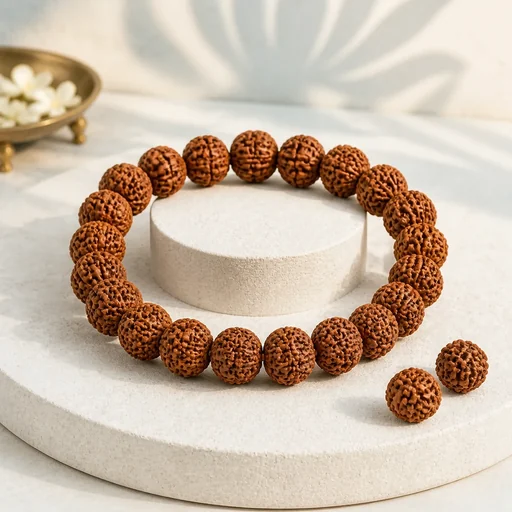
Most of the strand consists of beads arranged along a flexible foundation. During a counting practice, these are the elements advanced one by one. The foundation might be textile cord, elastic, or beading wire. Some malas place a knot between adjacent beads; others allow the beads to sit directly beside one another. An inter-bead knot can create space and limit how far beads travel if part of the strand fails, but it does not make a strand indestructible. Cord fiber, diameter, abrasion at each hole, finishing method, bead weight, moisture exposure, and handling all matter.
The visible material is only part of the story. A tassel may cover the terminal knot, and an opaque bead may hide the path of the cord. When construction is important, look for a close photograph of the junction and a written material description. If neither is available, ask rather than treating appearance as proof.
Guru bead, meru, and bindu
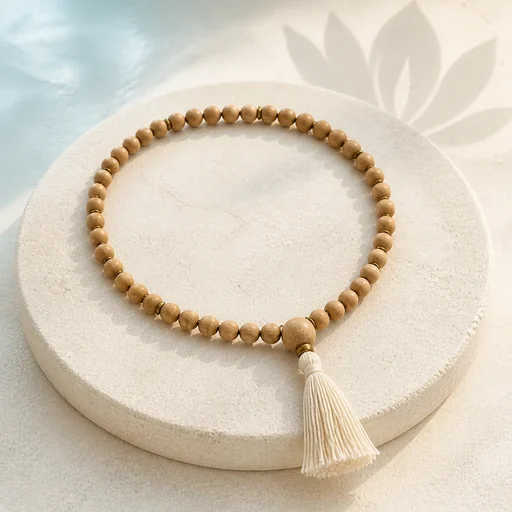
In many contemporary descriptions, the guru bead is the visually distinct component at the completion point of the loop. It may be larger, differently shaped, or drilled so that both sides of the strand enter it before the cord continues toward the tassel. Meru can name this same landmark. In some catalogs, bindu refers to a smaller finishing bead positioned beneath or beside it. These conventions are useful only when the author defines them; they should not be projected onto every mala.
The safest product description states what the component does and shows its construction: “one larger three-hole terminal bead,” for example, is clearer than a specialized term left unexplained. A reader can then decide whether that layout matches the intended practice. The name alone cannot establish the bead count, the correct direction of counting, or a religious lineage.
Markers, counter strands, pendants, and tassels
A marker is usually a bead that differs in size, shape, surface, or material and can be recognized by touch. It may divide the working loop into intervals, but not every contrasting element is intended to be counted. Some objects also have small suspended counter strands. DePauw University’s catalog, for instance, documents one Tibetan rosary with guru beads, two tasseled counter strings, and a final tassel. That is a record of a particular museum object, not a blueprint for all Buddhist or Hindu malas.
The tassel is a bundle of fibers attached at the terminal area. Structurally, it may cover or follow the finishing knot; visually, it gives the strand a clear endpoint. Symbolic readings of its fibers or color belong to particular communities and teachings. For condition assessment, the practical questions are more modest: Is the tassel firmly attached? Are fibers caught, matted, or pulling free? Is there slack where it meets the bead?
How to read product photographs and descriptions
A useful listing shows the whole mala, the terminal assembly, markers, and tassel in close detail. It also states the actual bead count, bead diameter, overall length, carrying material, and whether special beads are included in that count. Those facts cannot be recovered reliably from a styled photograph alone.
| Part | What to verify | What not to infer |
|---|---|---|
| Main beads | Actual count, diameter, stated material, hole and surface condition | Authenticity or geographic origin from color alone |
| Guru / meru / bindu area | Number of parts, cord route, functional count, seller's definition | One universal meaning across traditions |
| Markers | Position, tactile difference, intended role in the sequence | That every contrasting bead is a counting marker |
| Tassel and finish | Attachment, loose fibers, slack, symmetry, visible knot condition | Origin, age, or religious affiliation from tassel color |
Before choosing, record five answers: How many working beads are there? How is the terminal assembly named and shown? Are markers included in the working count? What carries the beads? What are the overall length and bead diameter? If a listing leaves one of these points unclear and that point matters to you, a precise question is more useful than an assumption.
Frequently asked questions
- Are a guru bead and a meru always the same thing?
- No universal rule makes them identical. Many descriptions use both names for the distinct bead at the completion point; others reserve them for different parts. Use the diagram or definition supplied for the specific object.
- Does every mala include a bindu?
- No. The term is absent from many descriptions, and a visible finishing component may have another name or may not be treated as a separate part. The construction should be described rather than guessed from terminology.
- Should a marker be counted like a regular bead?
- That depends on the designed sequence and the relevant practice convention. Shape and color do not answer the question. Check the product description and an authoritative source within your practice tradition.
- Can a photograph prove bead material or origin?
- A photograph can show visible color, shape, and texture, but it cannot by itself establish botanical or mineral identity, production location, age, or certification. Those claims require item-specific documentation or appropriate testing.
- Which photographs are needed to understand one mala's anatomy?
- A useful minimum is a scaled view of the entire relaxed loop, close views of the terminal assembly from both sides, the markers in sequence, and the tassel attachment. If the working count matters, request either a numbered diagram or overlapping photographs that let every bead be followed without gaps. Compare the images with written facts: working count, bead diameter, overall length, foundation material, and whether markers enter the count. This combination prevents a decorative element from being mistaken for a functional part and shows when the tassel conceals a finishing bead or knot.
Sources and further reading
Cultural and religious meanings are presented as context. They are not medical claims and make no promise of protection, transformation, or any spiritual result.