







Panchamukhi Up Close: How to Count Mukhi Lines and Describe the Actual Bead
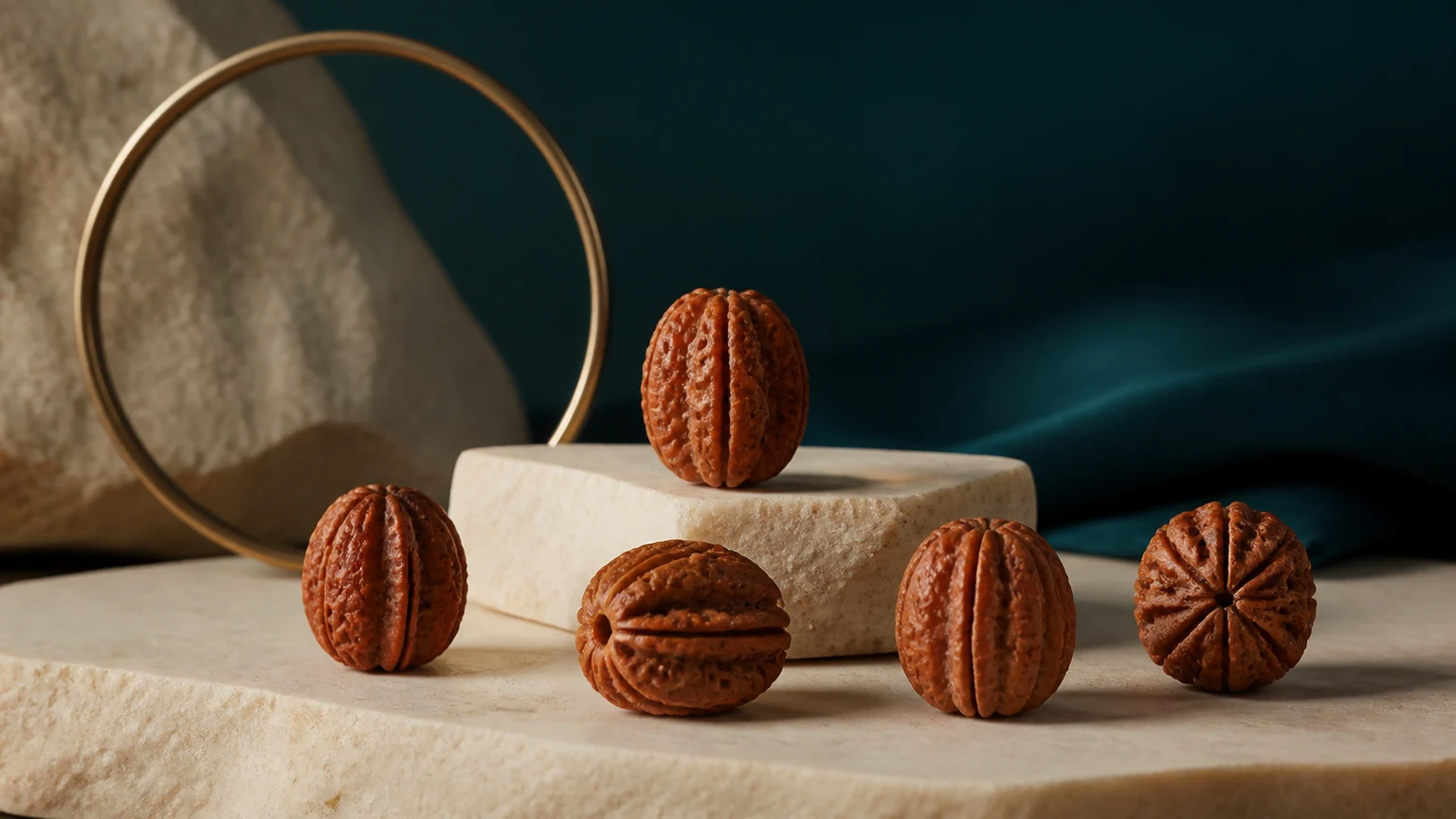
To count a panchamukhi bead, trace five natural longitudinal boundaries from one pole to the other while rotating the same specimen. Do not count shadows, short scratches, or cracks as independent lines. When part of the surface is hidden, the result should remain provisional.
What to count on a panchamukhi bead
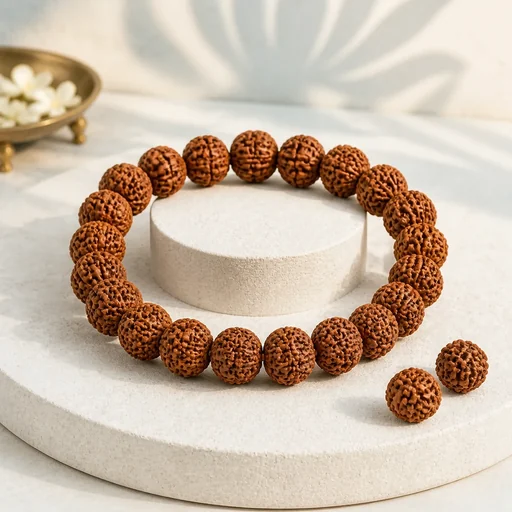
The hard rudraksha surface is a landscape of projections and depressions. In practical terminology, a mukhi boundary is a natural longitudinal groove separating adjacent surfaces and converging toward the poles. When five stable boundaries can be followed, the object is described as panchamukhi, or five-faced. This is an exterior description within an established traditional and commercial classification.
Not every dark depression is an additional boundary. Photographs may contain cast shadows, debris, superficial cracks, cleaning marks, and wear scratches. A candidate line has to remain recognizable across a sequence of angles and continue logically toward both ends. If a setting hides the groove or damage interrupts it, state that limitation.
Microscopy of the fruit stone associated with Elaeocarpus ganitrus describes a hard endocarp with complex cellular structure. That helps explain why the exterior is not geometrically regular. A boundary may be sharply recessed on one side and gentler on another. A sound counting method accommodates organic irregularity rather than expecting five straight, drawn lines.
Scientific names also require care. Kew treats Elaeocarpus ganitrus as a synonym of an accepted taxon. A product page may use the familiar word “rudraksha,” while a botanical determination requires appropriate evidence. Counting external sectors and identifying the plant are related, but they are not identical tasks.
A step-by-step count and item description
Use soft, diffuse light and a matte background. Do not write on or mark the bead. Place a removable paper pointer next to it and move the pointer only after completing one line. If the bead is already strung, do not pull on the cord for a better view; first determine whether both poles can be inspected safely without disassembly.
- Choose a starting line. Select the clearest groove and mark its position only on an image or external sketch.
- Trace its path. Confirm that it runs toward both poles instead of ending like a scratch.
- Rotate by a small increment. Identify the next boundary while keeping the previous one in view when possible.
- Complete the circuit. Count every boundary once until you return to the starting point.
- Check both poles. Observe how the five lines converge and whether cord or a cap covers part of the surface.
- Record limitations. Note hidden, soiled, damaged, or poorly photographed areas.
| Suggested wording | When it fits | Why it works |
|---|---|---|
| “Five longitudinal boundaries are traceable in the photo set” | All sides and poles are visible | Reports the observation without extending it |
| “Provisionally appears panchamukhi” | One area is hidden or image quality is limited | Preserves honest uncertainty |
| “Mukhi count is stated in report number…” | An item-linked report explains its method | Lets the reader verify the source of the conclusion |
| “Origin was not determined from photographs” | No traceable origin records are available | Keeps surface description separate from geography |
Finish with a neutral record: silhouette, two millimeter dimensions, color under ordinary light, channel condition, visible cracks, and stringing method. State whether the image is the item offered or a category example. The limits of an image are more useful to a buyer than an absolute phrase unsupported by the view.
Questions and answers
- Should I count ridges or depressions?
- Consistently count the longitudinal boundaries between sectors, then verify that they form five surfaces and converge toward the poles.
- What if one line splits?
- Do not add a face automatically. Follow both branches across other views; one may be a surface crack or irregular relief. Keep the conclusion provisional when uncertain.
- Do five visible lines prove authenticity?
- No. The count describes exterior configuration. Questions about material, alteration, and provenance require additional evidence and, when warranted, competent examination.
- Can I count lines on a finished mala?
- Yes, if each bead can be seen from multiple sides without stressing the strand. Do not disassemble a sound piece solely for casual inspection.
See current options and actual product photos in the Narayana Shop rudraksha collection. Match the stated mukhi count to the individual listing and its images.
Continue reading
Sources and further reading
- PubMed Central — microscopic description of the fruit and endocarp of Elaeocarpus ganitrus.
- Royal Botanic Gardens, Kew — taxonomic record for Elaeocarpus ganitrus.
- Smithsonian National Museum of Asian Art — mala and mantra recitation in an interpretation of Shiva Dakshinamurti.
This is a guide to visual description. It does not replace examination of the individual bead or determine provenance or effects from one exterior feature.