

How to Care for Rudraksha: Cleaning, Drying, Storage, and Inspection
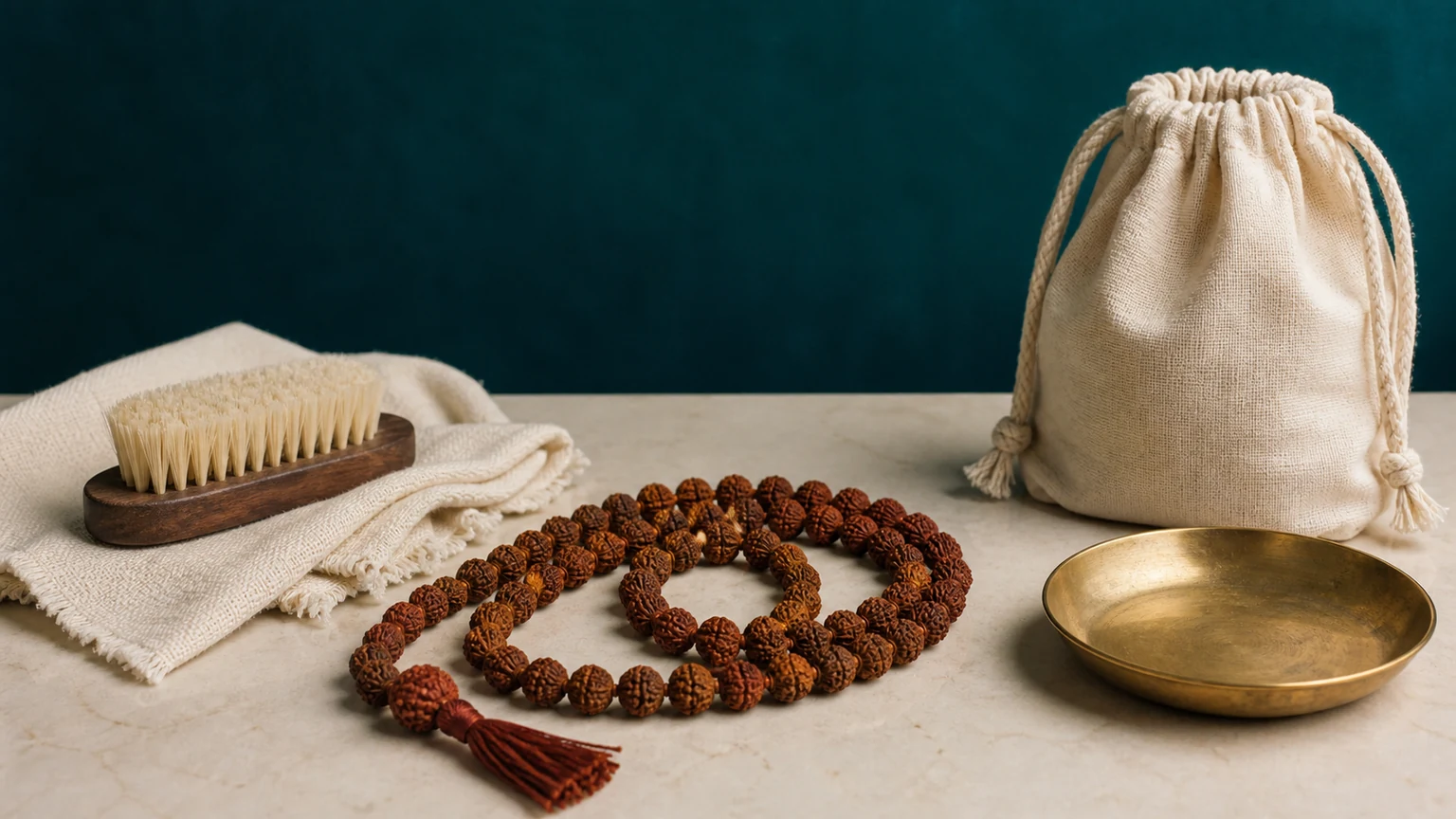
Rudraksha care comes down to four habits: inspect the piece regularly, remove loose dust with the least aggressive method, dry it fully after accidental wetting, and store it without pressure or abrupt humidity changes. Do not prescribe soaking, oils, detergents, or intensive cleaning until the bead, cord, fittings, and maker’s instructions have been checked.
Why rudraksha care starts with inspection
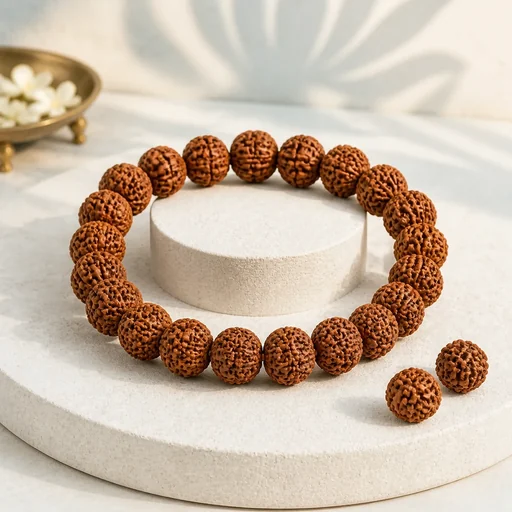
Microscopy describes rudraksha as the stony part of a fruit with a hard, lignified structure. Hardness does not make it invulnerable. Raised areas can abrade, a channel edge can split, and organic material responds to ambient moisture. A finished piece may also include textile cord, knots, tassels, metal, or stone, each with separate limitations.
A short inspection before cleaning prevents many mistakes. Work over a light cloth or tray so a component cannot disappear if the strand fails. Look for stretched cord, opening knots, and a new pale line near a channel. A fresh break may look different from old organic relief; when uncertain, stop pulling or flexing the area.
Soil is not uniform either. Loose dust can be removed without liquid. Skin oil or cosmetics adhere more strongly, while a hardened unknown deposit cannot be safely dissolved by one universal household product. Identify finishes and adjacent materials first. A mixed-media object should be treated according to its most sensitive component.
Museum guidance for wood emphasizes environmental stability. Wood absorbs moisture as relative humidity rises and releases it as conditions dry, and repeated cycles can contribute to dimensional change and cracking. A bead is much smaller than furniture, but the preventive principle remains useful: avoid extremes and sudden transitions.
A careful sequence for cleaning, drying, storage, and inspection
The sequence below is a conservative starting point, not a substitute for product instructions. Follow a verified maker’s method where one is supplied. For a valuable, damaged, or unidentified object, stop after a dry examination and consult a materials specialist.
| Stage | Conservative action | Avoid unless verified |
|---|---|---|
| Preparation | Remove the piece, wash and dry hands, and cover the work surface | Cleaning while worn or pulling the strand taut |
| Dry cleaning | Use light strokes with a soft cloth; brush only along the relief | Needles, stiff brushes, abrasives, or close-range compressed air |
| Accidental water | Blot without rubbing, arrange loosely, and allow free air circulation | Hair dryers, radiators, ovens, direct sun, or a damp sealed bag |
| After drying | Recheck channels, cord, knots, odor, and surface changes | Immediate wear while cord or tassel remains damp |
| Storage | Use a clean, dry, breathable pouch or separate box without tension | Bathrooms, windowsills, sealing a damp item, or stacking weight above it |
During dry cleaning, support the bead at a sound point rather than holding the tassel or adjacent knot. The brush must be clean and free of paint or cosmetic residue. Several light passes are safer than one forceful stroke. Do not try to make every recess equally pale; darker color may be natural, a prior finish, or part of the object’s use history.
If the piece is caught in rain, inspect it promptly. Blot moisture with an absorbent cloth, lay the mala in a relaxed loop, and turn it only without tension. Room-temperature air movement is preferable to directed heat. Before storage, make sure the areas near knots and between beads are dry as well as the visible surfaces.
Oil is not universal “food” for wood. The Canadian Conservation Institute notes that a stable environment cannot be replaced by coatings and that some polishes leave residues that change over time. Oil may darken relief, retain dust, enter the cord, or interact with a finish. Use it only when the maker identifies a compatible product and method for that item, and test discreetly first.
Keep a simple care record with date, condition, method, and any change. A photograph of the same area under similar light can reveal growth in a crack or stretching of the cord. A rigid monthly schedule is less important than checking after wetting, a fall, travel, or a snag.
Replacing a worn cord does not mean the beads are defective. The string carries stress and may age first. If a knot opens, a channel cuts into the fiber, or beads begin rubbing tightly, stop wearing the piece until repair. Photograph the order of components before any qualified restringing.
Questions and answers
- Can I rinse rudraksha under a faucet?
- Without item-specific instructions, avoid soaking or a strong stream. Water affects the cord, knots, adhesives, metal, and dyes as well as the bead.
- Do beads need regular oiling?
- There is no universal requirement. An unknown oil can alter color and trap debris. Apply only a verified compatible material according to the maker’s instructions.
- How do I know the piece is dry?
- Surfaces, spaces, knots, and tassel should be dry without cool damp areas or a new odor. Do not accelerate drying with heat.
- When should I seek repair?
- After a fresh channel split, opening knot, exposed core, corroding metal, persistent unknown soil, or an adverse change following cleaning.
See current options and actual product photos in the Narayana Shop rudraksha collection. Check materials and care notes on the individual listing before treatment.
Continue reading
Sources and further reading
- Canadian Conservation Institute — basic care of furniture and wooden objects.
- U.S. National Park Service — Museum Handbook: Curatorial Care of Wooden Objects.
- PubMed Central — description of the hard endocarp of Elaeocarpus ganitrus.
These preventive suggestions do not replace maker instructions or professional conservation. Account for every material in the individual piece.