







Anatomy of a Rudraksha Bead: Mukhi Lines, Natural Openings, and Organic Variation
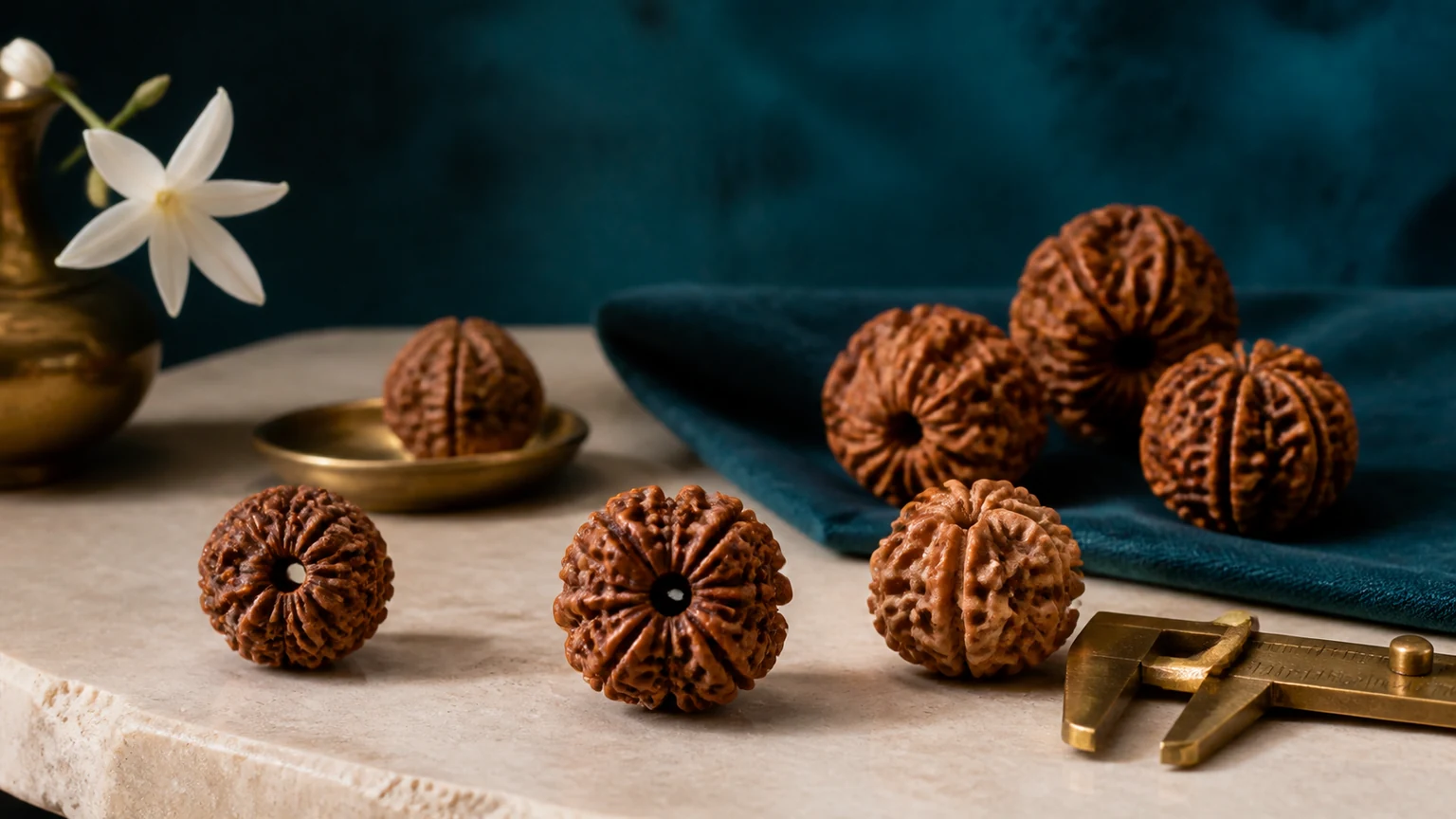
Rudraksha bead anatomy is best understood as the anatomy of a natural fruit stone: the exterior has longitudinal grooves, poles, texture, and a channel used for stringing, while the interior is hard and irregular. The term mukhi refers to visible longitudinal divisions, but a single photograph cannot establish the provenance, processing history, or authenticity of an individual bead.
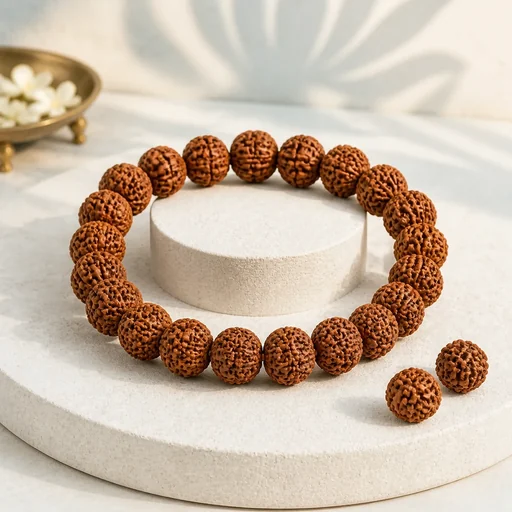
Rudraksha bead anatomy on the visible surface
In everyday jewelry language, “bead” describes the finished object after fruit tissue has been removed and the hard center has been prepared for stringing. Botanically, it is more precise to discuss the stony part of the fruit rather than an ordinary exposed seed. An open microscopy study archived by PubMed Central describes a hard endocarp made largely of sclereids, cells with strongly lignified walls. That durable layer carries the familiar relief after cleaning.
Four areas are useful during a visual inspection. First are the longitudinal depressions commonly used to distinguish mukhi divisions. Second are the raised surfaces between them. Third and fourth are the two poles where the lines converge. Color, roundness, depth, and symmetry vary naturally. Light direction, surface oil, dust, and aggressive photo editing can alter their appearance, so a perfectly uniform texture is not a sensible benchmark.
Mukhi is often translated as “face.” For a careful product description, it is clearer to refer to the continuous longitudinal sectors between natural grooves. Their number has a role in traditional classification, but it does not establish a measurable physical effect. Rarity, religious meaning, and observable structure are different categories of information and should be labeled accordingly.
The opening deserves similar precision. Internal spaces may occur in the fruit stone, while a maker may clear, widen, or fully drill a usable channel. “Natural opening” should therefore identify a documented observation or process, not function as a decorative synonym for authenticity. Tool traces around an entry point may reveal handling, yet they cannot identify the country where the tree grew or the person who finished the bead.
How to inspect photographs and item-specific descriptions
Begin with comparable evidence rather than promotional language. Look for evenly lit macro views of the side, both poles, and the channel. A millimeter scale is helpful. The listing should say whether the photograph shows the exact item offered or a category example. For an individual bead, the relationship among image, item number, measurement, and report matters; for a finished mala, a documented size range and honest note about variation may be more appropriate.
| Check | What it can show | What it cannot establish |
|---|---|---|
| Grooves traced between both poles | The visible surface divisions | Geographic origin or hidden alteration |
| Clear photographs of both poles | Where grooves converge and how the channel begins | The complete internal structure |
| Diameter, height, and weight | Dimensions of the measured object | Universal quality or religious significance |
| Unfiltered macro detail | Texture, cracks, residue, and possible tool marks | Botanical identity without supporting evidence |
| Report number and stated method | What a named examiner actually assessed | Anything outside that report’s scope |
Rotate the bead mentally through the photo series and follow each depression in sequence. A hard shadow may resemble an extra groove, while a high ridge may conceal part of a real one. If a cap, setting, or neighboring bead blocks the view, use limited language—“the available photographs show”—instead of presenting a final determination.
Organic variation is not automatically damage. Mild asymmetry and unequal relief are expected in plant material. For regular use, other details may matter more: a stable strand, no fresh split at the channel, a channel diameter compatible with the cord, and a transparent note about repairs. A nearly spherical silhouette is not inherently more functional than an irregular but sound specimen.
Questions and answers
- Does every longitudinal scratch count as a mukhi line?
- No. Visual descriptions look for a natural groove that forms the boundary of a longitudinal sector and can be followed between the poles. Scratches, cracks, and shadows can look similar, which is why multiple angles matter.
- Can the opening prove that a rudraksha is genuine?
- Not by itself. A channel can be cleared, widened, or drilled during finishing. Its shape helps describe condition and workmanship, but it does not automatically establish botanical identity, provenance, or the absence of other alteration.
- Why do beads of the same named type differ in size?
- Fruits develop under variable conditions, and cleaning and sorting also affect the final dimensions. Compare actual millimeter measurements and item photographs rather than relying only on a type name.
- Is one photograph enough to count mukhi lines?
- A strong set of views may support a preliminary description of a common bead. A single angle cannot rule out hidden areas or intervention. For a consequential purchase, connect the exact item with documented views, a clear method, and the limits of any report.
See current options and actual product photos in the Narayana Shop rudraksha collection. Check the individual listing because availability, dimensions, and documentation may differ.
Continue reading
Sources and further reading
- Royal Botanic Gardens, Kew — Plants of the World Online record for Elaeocarpus ganitrus.
- PubMed Central — microscopic description of the fruit and stony endocarp of Elaeocarpus ganitrus.
- Global Biodiversity Information Facility — taxonomic record for Elaeocarpus ganitrus.
This educational guide supports careful reading of an item description. It does not replace examination of the specific bead or promise physical or spiritual outcomes.