



What a Rudraksha Certificate Can—and Cannot—Prove
A rudraksha certificate can establish only that a named laboratory examined an identified specimen by stated methods and recorded particular findings. It does not automatically prove geographic origin, age, religious meaning, future durability, or any outcome from wearing the bead.
Is it a test report, opinion, or sales promise?
Retailers use “certificate” for very different documents: a seller’s card, an independent laboratory report, an X-ray image, a supplier letter, or a return guarantee. Each serves a different purpose. Begin with the heading and issuer. Who examined the object? Is that party also the seller? Are registration details and an official verification channel available?
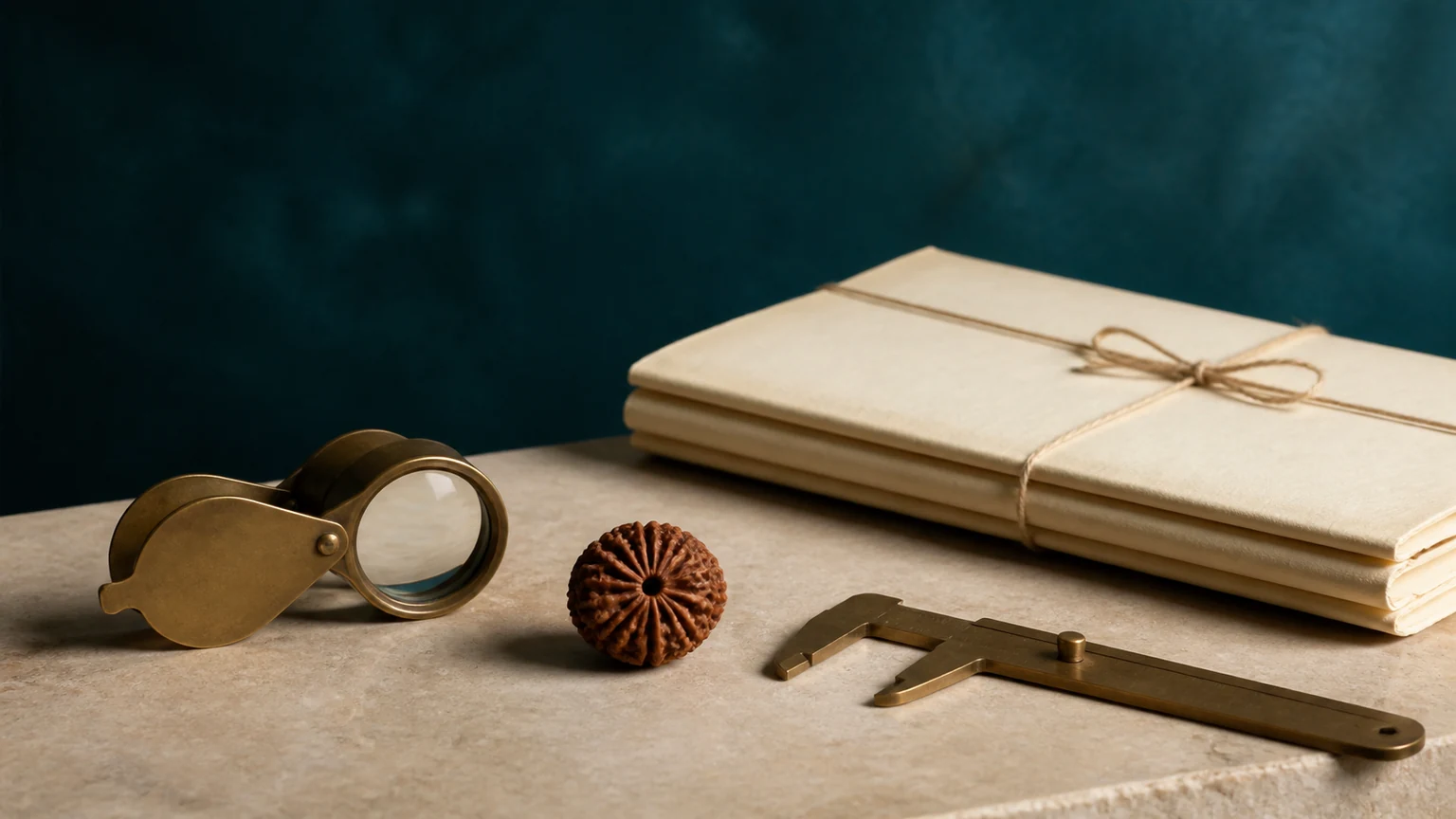
Next identify the specimen. Useful fields include views of the bead, sample number, dimensions, weight, and intake date. For a finished mala, determine whether the entire strand, selected beads, or one central component was examined. A report on a “lot sample” cannot silently be transferred to every item, and a document for a similar-looking bead does not belong to yours.
The method defines what the laboratory could observe. A visual exam records the surface; magnification can reveal grooves and tool traces; radiography may provide contrast from internal structure within the limits of image quality and projection. No method should be described as infallible or as answering a question that was not part of the assignment.
ISO/IEC 17025 addresses competence in testing and calibration laboratories. Even a reference to that standard requires the accreditation body, number, current status, and accredited scope. ILAC publishes its recognition arrangement and signatory structure, allowing users to reach the relevant national accreditation body. A logo without a verifiable record is not an adequate substitute.
How to read a rudraksha certificate field by field
Read from the top down and map every product claim to its evidence. If a listing calls a bead “certified,” the buyer should be able to answer: by whom, on what date, for which object, and for which characteristic? The table separates useful evidence from polished presentation.
| Field | What to verify | Common limitation |
|---|---|---|
| Number and lookup | Unique record, official issuer domain, matching result | A QR code may open a page maintained by the seller |
| Specimen | Images, dimensions, weight, markings, and condition | A generic name does not connect paper to object |
| Methods | Inspection, magnification, imaging, measurements, and conditions | An equipment list without findings proves little |
| Conclusion | Exact wording, signature, date, and examiner role | The conclusion applies only to examined characteristics |
| Provenance | The supply records or validated method supporting it | Appearance does not identify the country grown |
| Accreditation | Body, number, dates, and scope | Quality-system certification is not accreditation for a specific test |
Compare measurements with the actual bead while allowing for uncertainty and an irregular surface. One matching weight is weak identification; a combination of photographs, two dimensions, weight, and distinctive features is stronger. If the object was drilled, mounted, or damaged after testing, record that its condition has changed since the report date.
Read the conclusion literally. “Five internal regions observed” does not necessarily mean that the botanical species and geographic origin were established. “Natural” can refer to material, absence of a synthetic imitation, or one examined feature. Ask the issuer or seller to define it instead of expanding the term yourself.
Nepal, Indonesia, or Vrindavan claims need supply records: supplier, lot, date, and place of processing. A laboratory may characterize material, but geographic attribution requires a separate validated method or traceability. If the sole basis is a supplier statement, the product description should say so.
Keep a local copy or at least the report number and lookup date without republishing private data. An online page can change, while the record may matter for return, repair, or later examination. For a consequential individual purchase, confirmation can be requested directly through the issuer’s official channel.
Warning signs include no identifier, a nonexistent domain, logos without numbers, health or guaranteed spiritual conclusions, and claims that one home test answers every question. A warning sign calls for more verification; it is not, by itself, proof that the entire document is false.
Questions and answers
- Is a QR code enough?
- No. Check the domain, issuer, report number, image, and matching fields. A QR code is navigation, not independent evidence.
- Can an X-ray confirm mukhi count?
- It can provide information about internal structure when the image is adequate and interpreted by a competent examiner. The conclusion depends on specimen, projections, and method and should be read exactly as written.
- Does a certificate prove origin?
- Only if origin is within scope and the report names a verifiable basis. More often, origin is supported by supply-chain records rather than surface appearance.
- What should I do if the report is unclear?
- Verify the record with the issuer, request the accredited scope, and consider an independent second examination before irreversible work or a consequential purchase.
See current options and actual product photos in the Narayana Shop rudraksha collection. Check document availability and scope on each individual listing.
Continue reading
Sources and further reading
- International Organization for Standardization — ISO/IEC 17025 overview for testing and calibration laboratories.
- International Laboratory Accreditation Cooperation — ILAC MRA and signatory information.
- PubMed Central — microscopy of Elaeocarpus ganitrus structure.
This guide helps readers evaluate a document; it is not an opinion on any individual bead. Verify scope, method, and the report-to-item link.