








Tea and Herbal Blends: Reading Ingredients and Following the Maker’s Directions
To read an herbal tea ingredient list, begin with the product category and the complete declaration on the actual package. Then check allergens, net weight, maker or responsible party, batch, shelf information, storage, and the exact brewing directions supplied by the manufacturer. Do not invent quantity, temperature, or frequency by analogy. A blend may have a cultural history, but a shop should not promise treatment, detoxification, sleep improvement, or another effect absent from lawful labeling.
Move from the blend name to complete food labeling
The front may present morning blend, tulsi tea, masala, cleansing, or calm, but the back informs the decision. Determine whether the product contains tea leaf, herbal material, spices, fruit pieces, flavors, sweeteners, or other components. Do not call a multi-ingredient blend a single herb, and do not assume the word tea proves the presence of Camellia sinensis.
Compare the original and destination-language labels. Preserve plant names without improvised substitutions; retain the botanical name or plant part when given. Do not guess an abbreviation. EAEU TR CU 022/2011 provides a food-label framework including product name and ingredients; qualified compliance review must determine whether a particular batch meets the rules.
Locate allergens and cross-contact statements separately. FDA tells consumers with food allergies to read labels and identifies how major allergen sources are declared in its system. Allergen lists vary between markets, so U.S. guidance does not replace EAEU requirements. A may-contain statement does not quantify exposure, but it remains material information for an allergic consumer.
Check net weight, manufacturer, importer or responsible organization, lot, date, shelf life, and storage. A clear window shows appearance but does not establish species, purity, or origin. Do not infer country of harvest from Indian design. If a pouch is unsealed, damp, insect-damaged, moldy, or appears to have an altered date, do not brew it before contacting the seller.
| Field | Verify | Do not add |
|---|---|---|
| Name | Intelligible product type | A therapeutic purpose from a poetic name |
| Ingredients | Every component and its order | Unlisted herbs or guessed percentages |
| Allergens | Ingredients and cross-contact notice | An absence guarantee without evidence |
| Brewing | Quantity, water, and time from directions | An internet-average recipe |
| Batch and shelf | Legible codes and storage | Origin or freshness from appearance |
Follow directions and protect the blend
Transcribe the directions without improving them: product amount, water volume and temperature, steeping time, and whether another infusion is permitted. If one parameter is absent, do not insert a universal number. Plant parts and particle size behave differently, and the manufacturer is responsible for its formula. An article may explain the fields but should not create a new dose.
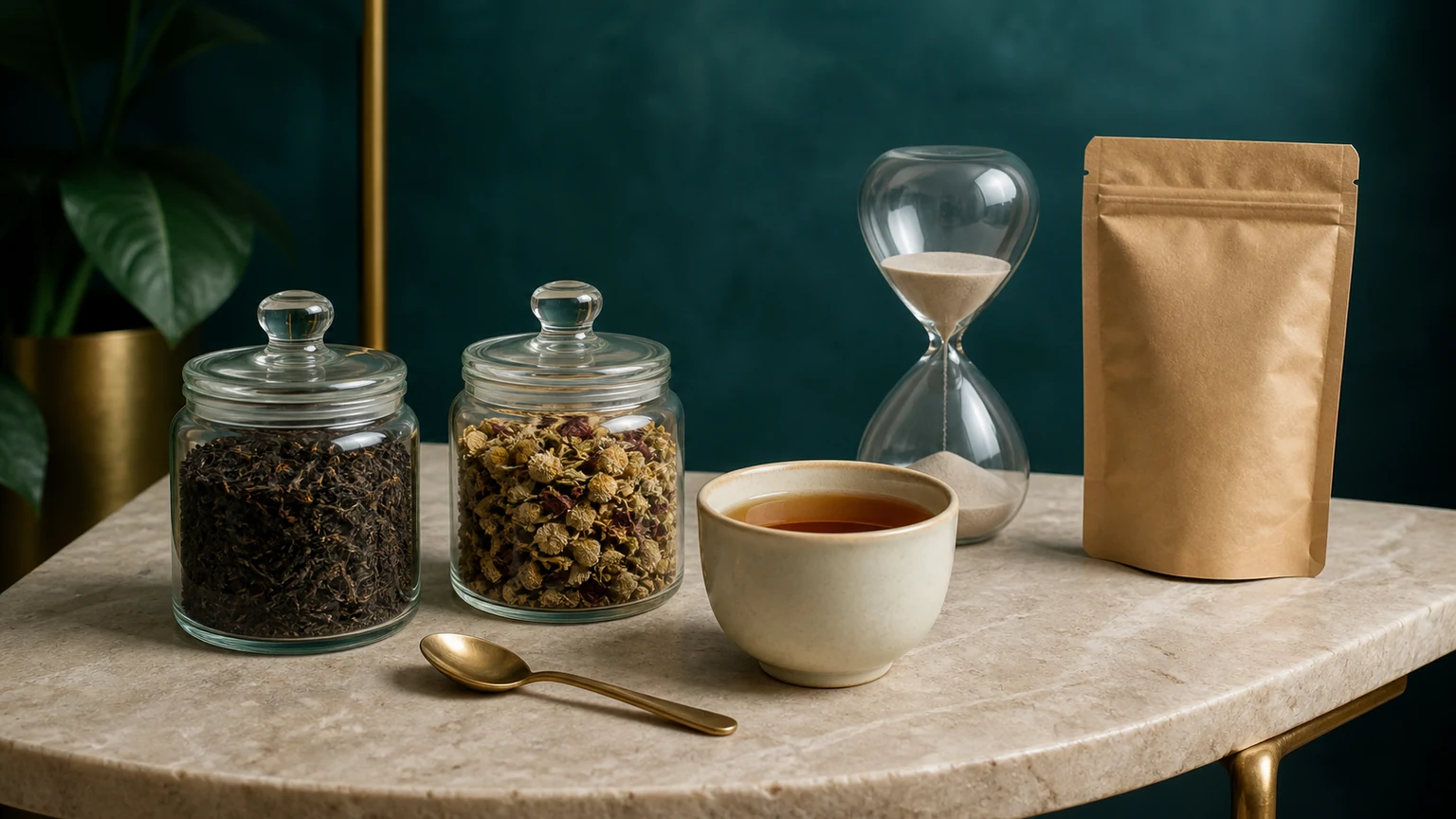
Use clean vessels and water, and keep the measuring spoon dry. Close the package promptly. Never return wet leaves to the shared pouch or mix batch remnants. Store under the label conditions, generally away from moisture, strong odors, direct light, and heat. Tea and herbs readily take on surrounding aromas, so a sealed dedicated container can protect the intended profile.
Briefly inspect the blend each time. Natural variation in particle size may be normal; damp clumps, webbing, live insects, mold, a markedly rancid odor, or package damage are stop signals. Do not attempt to dry and recover a questionable food blend. Keep images, the batch code, and proof of purchase for the seller.
Do not use tea as self-treatment or replace prescribed care with it. Herbs may matter within Ayurveda or family traditions, but a formula does not become medicine because of a story. For allergy, pregnancy or breastfeeding, medication use, chronic conditions, or a child, show the complete ingredients to a qualified physician or pharmacist.
- Identify the product category and read the whole package, not only the front name.
- Compare the complete ingredients on the original and translated labels.
- Locate allergens, cross-contact notices, and use restrictions.
- Check maker, responsible party, net weight, batch, shelf life, and storage.
- Repeat quantity, water, and time exactly from the maker’s directions.
- Use a clean dry utensil and reseal the package immediately.
- Stop for damage, dampness, insects, mold, or an unusual odor.
- Do not attribute a therapeutic outcome or alter medical care.
Final practical review: To repeat a preferred cup, record only label-directed parameters and a sensory note: batch, opening date, stated amount, water, time, and package condition. Do not turn “I liked it” into a health recommendation or new dose. Read the label again with a new batch because ingredients and particle size may change. The record supports flavor consistency without replacing food directions.
Questions and answers
- If the label gives no water temperature, may I use a universal one?
- Do not present a guess as the maker’s direction. Ask the manufacturer or seller; parameters depend on the exact blend.
- Does tulsi on the front mean the pouch contains only tulsi?
- No. It may be a multi-ingredient product name. The complete declaration on the actual package controls.
- Can natural tea cause an allergic reaction?
- Natural origin does not rule out allergy or sensitivity. Read ingredients and warnings, and seek professional advice for a known allergy.
- May I keep tea in an open pouch?
- Follow the label. Tight closure and protection from moisture and odors commonly help, but the maker sets the shelf and storage conditions.
- Can I drink the blend during pregnancy or with medication?
- Do not decide from shop copy. Show the complete ingredients to a physician or pharmacist familiar with your circumstances.
See current options and actual product photos in the Narayana Shop Ayurveda and yoga collection. Verify current ingredients, allergens, and directions on the selected blend’s package before ordering.
Continue reading
Sources and further reading
- Eurasian Economic Commission — TR CU 022/2011 on Food Product Labeling.
- U.S. Food and Drug Administration — Food Allergies and Labels.
- Rospotrebnadzor — What to Check on a Product Label.
This article creates no brewing dose beyond the maker’s directions and provides no medical advice. Allergy, pregnancy, medication, and pediatric questions require a qualified professional.