














Eco Materials Without Greenwashing: Product Claims You Can Actually Verify

Eco materials without greenwashing are described through verifiable characteristics: exact fiber composition, the stated share of a component, durability features in a particular construction, repair access, and documented packaging facts. Words such as “green,” “eco-friendly,” “ethical,” or “biodegradable” are too broad without a criterion, boundary, and evidence. A responsible product page tells readers exactly what was checked, by whom, when, and which part of the offer the conclusion covers.
Turn one big promise into small, testable claims
The FTC cautions against broad, unqualified claims such as “green” and “eco-friendly,” because consumers may read them as an overall environmental benefit that is difficult to substantiate. The European Commission likewise centers reliability, comparability, and verification. In practice, replace “eco bag” with a bounded statement such as “the supplier specification lists the outer fabric as 70% hemp and 30% cotton; the batch record was reviewed on this date,” but only when that is the evidence in hand.
Every statement needs a boundary. Outer-fabric composition says nothing by itself about lining, thread, zipper, or packaging. A reusable mailer does not make the product or delivery system sustainable. A replaceable buckle does not establish a low carbon footprint. Narrow wording lets a reader understand what the document supports and what remains outside its scope.
Check the date and level of evidence. A supplier specification is a primary record of what the supplier declares, not an independent laboratory result. A certificate may be third-party evidence, but its issuer, number, scope, validity, and named organization in the chain still require review. A store photograph can verify a seam on one item; it cannot document labor conditions.
Comparisons require a baseline. “Thirty percent less packaging” is incomplete without a previous version, unit, period, and consistent boundary. “Lasts longer” needs a method or longitudinal evidence, not one impression. When that evidence is absent, show a measurable feature—material weight, replaceable hardware, or reinforcement at a load point—without turning it into a total environmental rating.
| Claim | Evidence needed | Careful wording |
|---|---|---|
| Fiber content | Batch specification or test | State the percentage and product component |
| Certified | Number, registry, scope, and validity | Name the standard and covered process |
| Reusable packaging | Photo, material, and construction | Do not transfer the attribute to the product |
| Repairable | Accessible seam, replaceable part, directions | Describe the specific feasible repair |
| Reduced impact | Comparable study with defined boundaries | Name the metric, baseline, and period |
A seven-step product-page audit
Highlight every environmentally suggestive word and ask whether it is a fact, interpretation, or slogan. Nouns and numbers are generally easier to verify than adjectives. “Outer fabric contains…,” “buckle can be replaced…,” and “box is designed for reuse…” create concrete questions. “Conscious,” “clean,” and “kind to the planet” create atmosphere unless they are defined.
Open the underlying evidence. It must connect to the same item, batch, or process—not merely to a similar material. If a standard is named, read that program’s claim rules. ISO’s introduction to the 14020 family distinguishes approaches to environmental labels and emphasizes accurate, credible information. Mentioning a standard is not the same as meeting it.
Consider materiality and tradeoffs. A small improvement in one component should not be presented as an overall advantage when other stages have not been studied. Natural origin does not automatically establish low impact, safe chemistry, fair labor, or biodegradation of a finished composite. Conversely, the absence of a grand label does not erase the value of a robust seam or repair access; those are simply narrower facts.
Finally, keep the evidence version and review date. Composition, suppliers, packaging, and certificates can change. The product page should change with the batch or retire an outdated claim. For Narayana Shop, the sound standard is to publish what can be shown without exposing private supplier data and to use neutral material language whenever substantiation is incomplete.
- Underline eco-friendly, sustainable, ethical, organic, biodegradable, and similar terms; require a definition.
- Identify whether the statement covers the product, one material, packaging, delivery, or the company.
- Locate the document, number, date, scope, and owner of the claim.
- Confirm that the batch, material, and process match the item being offered.
- For a comparison, find the baseline, metric, period, and consistent boundaries.
- Separate durability and repairability from a complete life-cycle conclusion.
- If evidence is missing, replace the slogan with a neutral verifiable fact or remove it.
Final practical review: Keep a claim register outside the promotional copy: exact phrase, object, record, evidence owner, review date, validity, and public verification route. Add what the record does not support. Recheck it with each batch and remove outdated wording from both languages, alt text, metadata, and listings. This prevents one documented component from silently becoming a claim about the entire product, company, or supply chain.
Questions and answers
- Is a natural material always greener than a synthetic one?
- No. A fair comparison needs aligned boundaries covering raw material, processing, durability, care, transport, and end of use. Origin alone cannot settle the result.
- Can a seller use organic based on a supplier statement?
- Only when the applicable rules are known and the documentation covers that material and chain. Otherwise, report the exact specification without adding a status it does not prove.
- Does reusable packaging make a purchase sustainable?
- It establishes only that the specific package can be reused. Actual reuse and total impact depend on behavior, materials, transport, and the broader system.
- How do I check an environmental label?
- Find the program owner, criteria, independent certifier, registry entry, scope, and validity. A homemade icon or unverifiable logo is not certification.
- Does heavy fabric prove durability?
- Fabric weight is one input. Seams, stress points, hardware, repair, and use data also matter. Describe those features instead of promising an undefined service life.
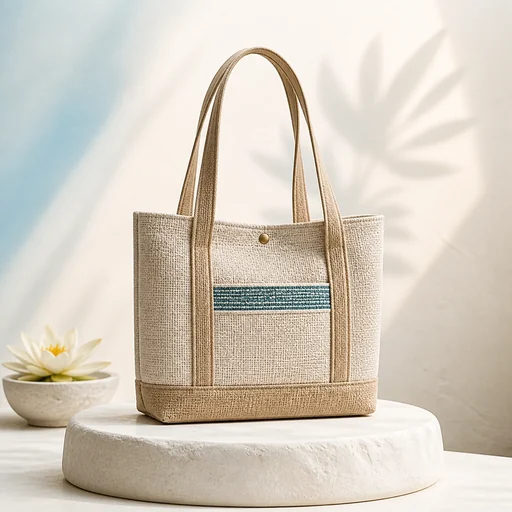
See current options and actual product photos in the Narayana Shop hemp backpacks and bags collection. Evaluate composition and construction on the individual listing rather than relying on a general eco impression.
Continue reading
Sources and further reading
- U.S. Federal Trade Commission — Environmental Claims: Summary of the Green Guides.
- European Commission — Green Claims.
- International Organization for Standardization — Environmental Labels.
This article explains claim review; it does not assign any item certification, organic status, biodegradability, ethical status, or life-cycle advantage without specific documentation.