





Choosing a Hemp Belt Bag: Fit, Pockets, and Phone Size
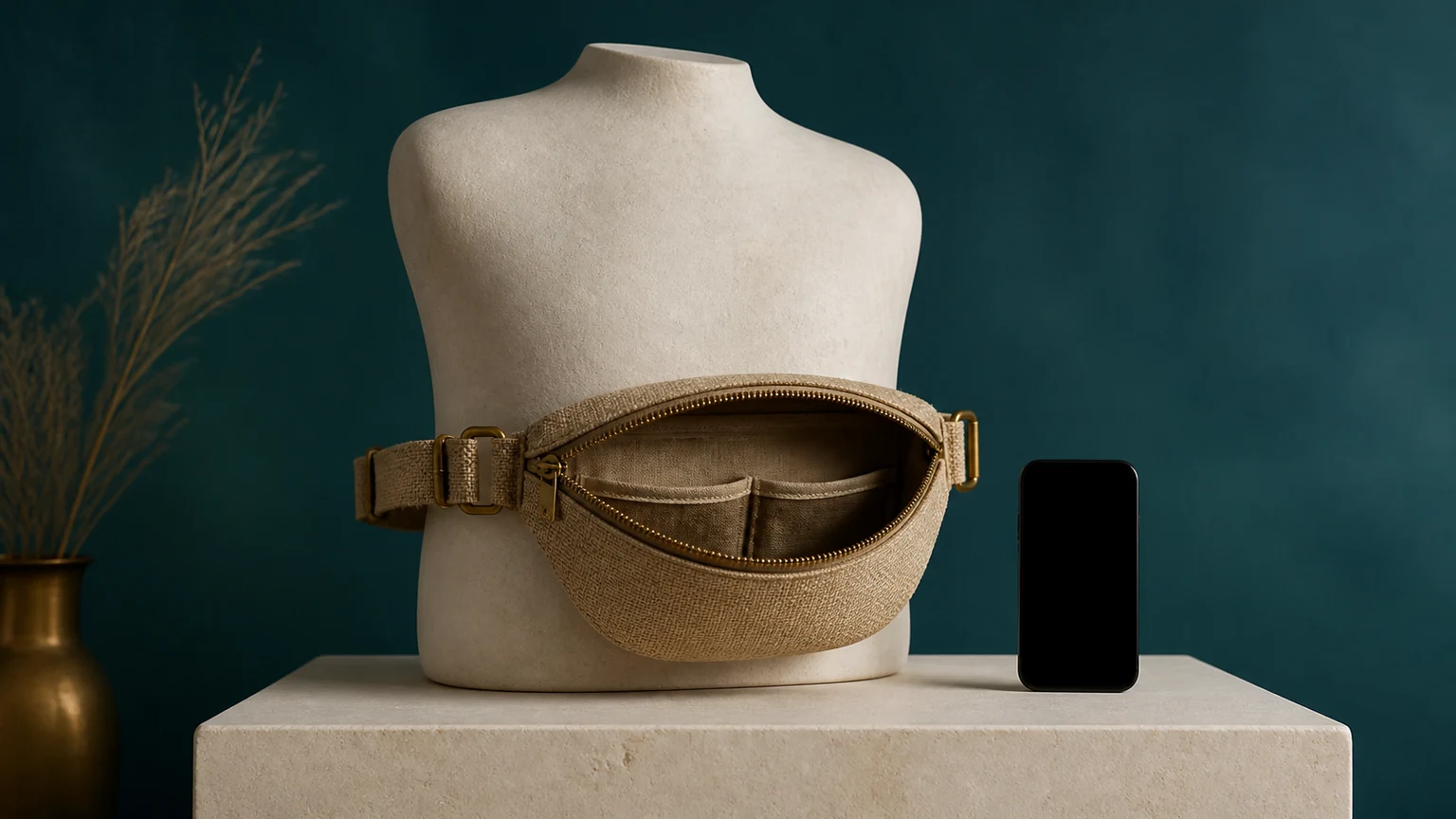
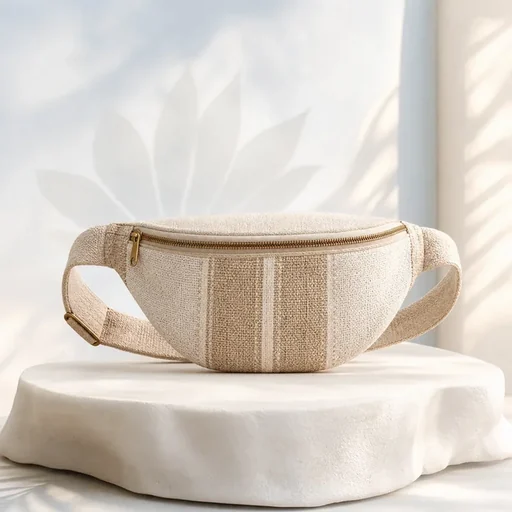
How do you choose a Hemp belt bag without trying it on? Compare two sets of measurements. The first is the bag's full closed circumference at shortest and longest settings, with body, strap, buckle, and fixed gaps documented. The second is your circumference at the intended wearing point over typical clothing. For phone fit, measure width, height, and thickness in the everyday case, then compare those figures with the pocket cavity, opening, zipper path, and internal seams. No one-size label can guarantee waist, hip, or crossbody fit.
Circumference and fit without a one-size claim
Close the buckle and measure the complete loop along the centerline of bag body and strap at shortest and longest settings. Separately record body, webbing between attachment points, buckle, and fixed inserts. These components provide a cross-check if total circumference does not match the parts. Loose strap length alone is not the wear range because it omits the bag body and hardware.
Measure your intended wearing point with a flexible tape over typical clothing: waist, hips, or crossbody path. The tape should neither dig in nor hang loose. Add a preferred comfort margin and make sure the result sits within, not at the edge of, the bag's range. Clothing size cannot substitute because brand charts and body locations differ.
Crossbody wear generally needs a longer loop than waist wear and changes where the bag body, buckle, and adjuster sit. Strap width, edge finish, and hardware position matter alongside length. Fit photos can show consenting people with circumference, clothing, adjustment, and wearing mode disclosed. A single model never represents every body.
Do not claim fits everyone even when the measured range is broad. People differ in circumference, proportion, clothing, mobility, and preferred ease. Inclusive product information gives exact minimum and maximum, explains the method, and shows several references. If a buyer's desired number is only barely inside the range, that is not evidence of comfort; leave adjustment reserve.
| Field | How to measure | Inadequate shortcut |
|---|---|---|
| Full circumference | Closed loop along center at minimum and maximum | Loose strap length alone |
| Personal measure | Intended wear point over typical clothing plus ease | Pants or dress size |
| Phone | Cased width, height, thickness plus pocket opening | Screen diagonal or the word smartphone |
| Fit | Photos with circumference, clothing, setting, and mode | One model or fits all |
Pockets, phone, and load points
Exterior body dimensions do not equal usable pocket capacity. Measure clear internal width, height, and depth and the width and shape of each opening. Record lining thickness, corner curves, seam allowances, zipper teeth, and how the slider narrows entry. On a curved pocket, a straight outer ruler can overstate usable space.
Measure the phone in its everyday case across the widest, tallest, and thickest points. Compare it with both cavity and opening, and ensure the zipper closes without rubbing a rigid case or tensioning the seam. The phone should not press a buckle from inside or prevent full closure. Official iPhone 16 dimensions from Apple can be a transparent reference, but they do not replace a buyer's cased-device measurements.
For photography, use a blank inert dummy with documented dimensions rather than a live phone containing personal data. Show entry, full seating, zipper closure, and remaining clearance. Never force a rigid reference into a pocket or imply that one successful phone represents every model sold under the same screen-size description.
Macro photographs should cover pocket seams, strap entries, buckle, adjuster, zipper stops, and webbing edges. Check skipped stitches, loops, burrs, play, distortion, and narrow seam capture. ISO 13935-2 demonstrates that seam rupture force is a separate test; attractive double stitching is not a load rating. Do not publish kilograms unless the complete bag passed a disclosed protocol.
- Measure full closed circumference at minimum and maximum.
- Measure your intended wearing point over typical clothing with ease.
- Compare the cased phone in three axes with pocket and opening.
- Inspect macros of buckle, adjuster, webbing attachments, zippers, and seams.
- Avoid universal-fit and untested load claims.
Questions and answers
- How do I compare the bag's range with my body?
- Measure the intended wear point over usual clothing, add preferred ease, and make sure that number falls comfortably inside the full circumference range.
- Can clothing size replace a body measurement?
- No. Size charts vary and do not provide the waist, hip, or crossbody path where the bag will sit.
- Will a phone fit if it is narrower than the bag exterior?
- Not necessarily. Seams, lining, curvature, and zipper reduce usable space. Compare three internal dimensions and the opening.
- Is a long strap enough for crossbody wear?
- Only when full maximum circumference exceeds your crossbody measurement with margin. Also consider strap width, buckle position, and clothing.
Compare measured circumference ranges, pockets, hardware, and actual photos in the Narayana Shop hemp belt bags collection. Match a phone by its cased dimensions and the pocket opening.
Continue reading
Sources and further reading
- National Institute of Standards and Technology — SI units for length.
- ISO 13935-2:2026 — maximum force to seam rupture.
- Apple — iPhone 16 technical specifications as a size reference.
Circumference ranges and fit photos are not universal guarantees. Measure a phone in its everyday case and compare all three dimensions with the pocket opening and cavity.