


How to Clean Hemp Bags and Wallets Without Shrinkage
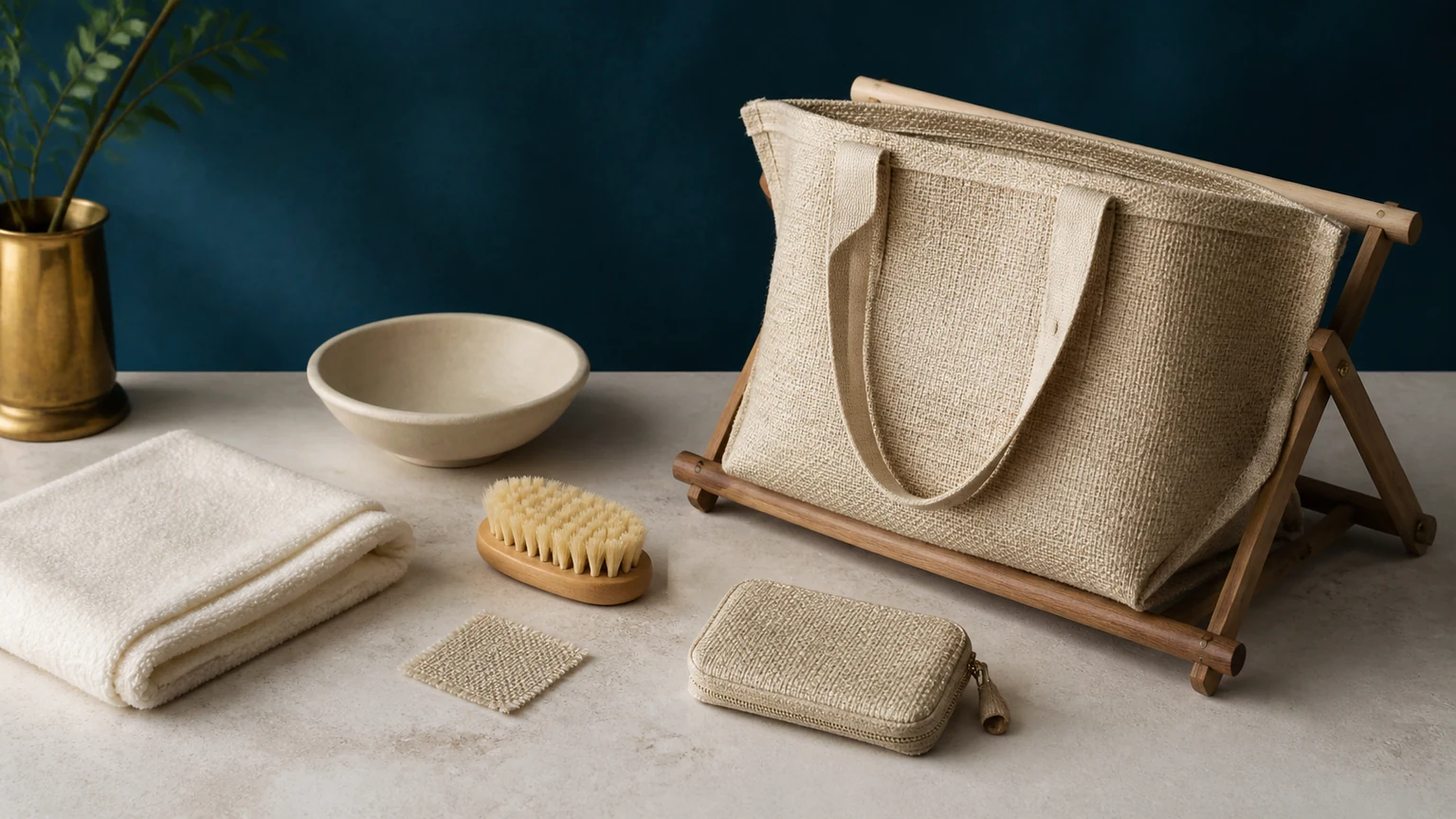
If you are learning how to clean a hemp bag, begin with its care label, construction, and an inconspicuous test—not with a basin of water. A fiber name does not describe the lining, interfacing, dyes, leather, metal, adhesive, or trim. No remote method can therefore guarantee zero shrinkage. The cautious sequence is to empty the item, remove loose dry soil, test color and shape locally, and use wet cleaning only when the maker permits it for that particular construction.
Treat the bag as a construction, not a single fiber
A listing that says “hemp bag” may describe only the face fabric. Inside, there may be cotton or synthetic lining, nonwoven stiffener, bonded seams, zippers, snaps, dyed cord, or trim of unknown composition. When wet, those parts do not respond alike: one textile may change dimensions, another may remain stable, an adhesive may soften, and a dark edge may bleed. Examine the item in good light and record every material that is visible or stated on its label.
Read the words as well as the symbols: whether immersion is allowed, the maximum temperature, bleach restrictions, tumble drying, ironing, and professional cleaning. Canada’s consumer guide explains that these care processes are communicated separately. A missing label is not permission to wash. Ask the seller or maker for item-specific directions and default to reversible dry surface cleaning while the answer is unknown.
Before treatment, photograph the front, base, corners, lining, and existing wear. Measure width and height between repeatable points without pulling the fabric. Mark stains, abrasion, and preexisting asymmetry. This record does not turn home care into a laboratory trial, but it makes a change in dimensions, color, or form easier to detect before another round of cleaning compounds the problem.
Loose dust and crumbs often need no water. Remove detachable inserts, use a clean soft brush along seams, and, on a sound item, consider low suction through a protective screen. Conservation guidance is intentionally cautious because it addresses museum textiles. For a modern bag, its value lies in the principle of minimum intervention; it does not override the maker’s care directions.
| Area | What to verify | Why it changes care |
|---|---|---|
| Face fabric | Fiber content, dye, print, coating | Water and friction may alter color or texture |
| Lining | Material, ease, attachment to shell | Different shrinkage can pull the body out of shape |
| Interfacing | Bonded layer or removable insert | Moisture can change stiffness and form |
| Hardware and trim | Metal, wood, leather, dyed cord | Each material has different moisture limits |
| Soil | Water-based, oily, colored, or unknown | An aggressive cleaner can spread or set the mark |
A conservative cleaning and drying sequence
Begin with a local test. On a hidden area, gently press a white lint-free cloth barely dampened with water at the temperature allowed by the label. Do not rub. Look for color transfer immediately and after drying, then compare texture and dimensions. The Canadian Conservation Institute stresses that colorfastness testing is only one factor and is not foolproof. Test each color, piping, and thread separately because their stability may differ.
If the label permits only surface or spot cleaning, do not turn that direction into soaking. Put the smallest amount of an approved cleaner on the cloth rather than pouring it on the bag; work from the edge of the mark inward and blot with a clean white cloth. Do not mix household chemicals, and avoid bleach, alcohol, oils, or stain removers unless the directions explicitly allow them for every component.
Full hand washing is appropriate only when the maker clearly permits it and the preliminary checks pass. Support the entire body, never wring it, and do not lift a heavy wet bag by its handles. After a short treatment, remove moisture by blotting between clean towels. Do not advertise “no shrinkage”: yarn structure, weave, finishing, prior treatment, and the lining all affect dimensional change.
Dry at room conditions, away from radiators, hair dryers, direct sun, and hot airflow. Align seams and support the volume with clean, pale, non-bleeding material, but do not overstuff and stretch the shell. Leave pockets open, blot hardware, and change the bag’s position periodically. Store it only when the interior and the space beneath the lining are completely dry.
- Find and photograph the care label; ask for directions if it is missing.
- Identify the shell, lining, interfacing, hardware, and detachable parts.
- Record original measurements, form, color, stains, and existing damage.
- Remove loose dry soil first with a soft brush or protected low suction.
- Test each color and trim on a hidden area with a white cloth.
- Use minimal moisture and only an approved cleaner; do not scrub or wring.
- Air-dry without heat, support the form, and remeasure only when fully dry.
Final practical review: After complete drying, compare the item with the before images and measurements. Record the cleaned areas, product used, contact time, and drying method. If lining puckers, a seam ripples, color transfers, or stiffness changes, do not repeat the treatment or stretch the item while damp. This brief record becomes item-specific care evidence without pretending that another bag will respond the same way.
Questions and answers
- Can I machine-wash a hemp bag?
- Only when the care label for that exact item allows it. A lining, bonded layer, or hardware can rule out machine washing even when the face fabric feels robust.
- Does cold water eliminate shrinkage?
- No. Lower temperature removes one stressor, but yarn, finishing, agitation, wet time, and neighboring materials also affect dimensional change.
- How should I treat one stain?
- Identify the soil and test an approved cleaner in a hidden area first. Blot rather than scrub; take persistent, oily, colored, or unknown stains to a qualified cleaner.
- May I dry the bag in direct sunlight?
- Direct sun and heat can create uneven drying and alter some dyes. Gentle airflow at room conditions is the safer default unless the label says otherwise.
- What if the test cloth picks up color?
- Stop wet cleaning, let the test area dry, and ask the maker for a compatible method. Do not try to set the dye with an improvised household treatment.
See current options and actual product photos in the Narayana Shop hemp wallets and accessories collection. Check the materials and care directions on the individual listing before cleaning.
Continue reading
Sources and further reading
- Canadian Conservation Institute — Mechanical Surface Cleaning of Textiles.
- Canadian Conservation Institute — Testing for Colourfastness.
- Canada Office of Consumer Affairs — Guide to Apparel and Textile Care Symbols.
This is a conservative care framework, not a zero-shrinkage guarantee. The maker’s directions and a test on the actual item take priority; entrust valuable or complex pieces to a qualified textile professional.