


Flute, Peacock Feather, and Radha-Krishna: Visual Language in Handcrafted Objects
Radha Krishna symbols are not a universal kit with one fixed meaning. A flute can help identify Krishna in a particular composition; a peacock feather must be distinguished from any colorful ornament; and a Radha-Krishna scene depends on text, school, region, and artist. In a product description, the responsible method is to describe visible features, cite the source of an attribution, and state what remains unknown. The image itself does not promise romantic harmony, protection, emotional healing, or a spiritual result.
How museum records read a composition
A museum record begins with object type, date, region, material, and subject rather than a secret symbolic formula. The Met's early twentieth-century chromolithograph shows Krishna playing a flute beside Radha in a forested theatrical setting; its record identifies Malavli near Mumbai, medium, date, and dimensions. Those facts support comparison of posture, attributes, and setting. They do not let a contemporary object borrow the print's date, provenance, or interpretation merely because two figures look similar.
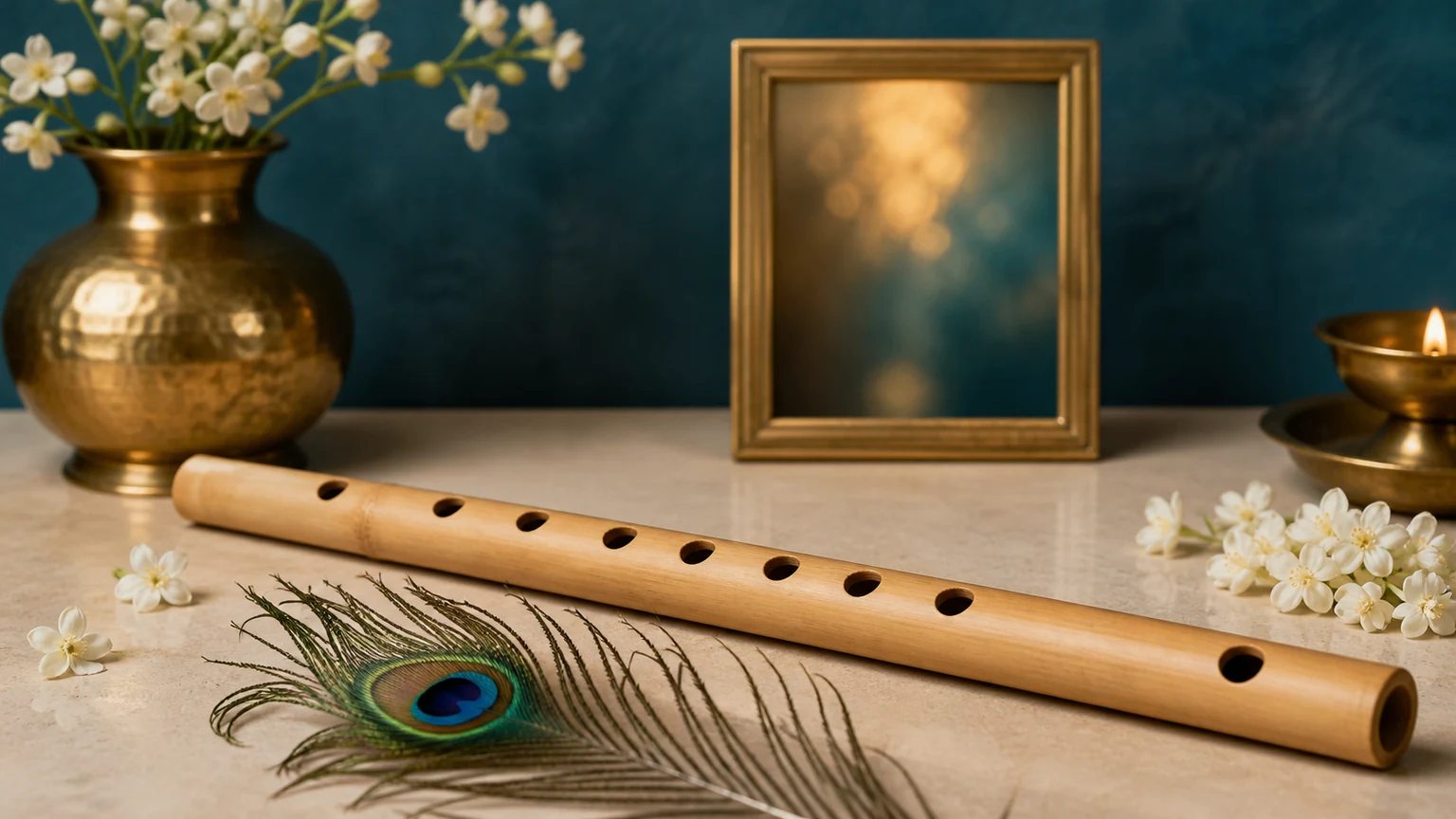
The flute is a strong clue only when it is visible as an instrument. A British Museum image shows a figure playing a transverse flute, and the posture of both hands contributes to the attribution. A short cylinder in a small carving may be another object. Examine the entire silhouette, the figure's position, associated attributes, the maker's description, and any inscription before naming the character. If the detail cannot be resolved, describe a flute-like element and record the uncertainty.
A peacock feather is usually recognized through its shaft, vanes, and eye pattern. Stylization may remove several of those cues, so a single blue-green teardrop does not establish a bird species or a Krishna reference. When a maker identifies the motif, keep that authorial statement distinct from broader religious interpretation. Color also changes across pigments, printing, screens, and wear; it is especially weak evidence for iconographic identity.
Paired imagery asks for more context, not less. Pose, gaze, touch, landscape, architecture, inscription, and attendant figures may connect a scene to a literary episode or regional school. The British Museum and Met records demonstrate how title, material, period, and place travel together in a responsible attribution. Without those data, a neutral description such as two figures in a garden can be more accurate than a sacred name that cannot be checked.
| Detail | Checkable evidence | Limit of the inference |
|---|---|---|
| Flute | Shape, hand position, full figure, museum or maker attribution | Not every wind instrument identifies Krishna |
| Peacock feather | Shaft, vanes, eye pattern, and documented design intent | Color alone proves neither species nor meaning |
| Paired figures | Attributes, pose, inscription, subject, and artistic school | Two figures are not automatically Radha and Krishna |
| Handcrafted object | Material, dimensions, technique, actual photos, and maker | A motif does not prove date, place, or provenance |
From visual language to an honest object description
A useful listing shows the complete object, a close view of the motif, the reverse, edges, and attachment points. For a painting, include overall dimensions, image boundaries, support, printing or painting technique, signature, and hanging method. For carving, show depth, joins, surface wear, and repairs. These facts determine whether an object suits a room and how it should be handled; a generic sentence about divine love does not replace them.
Claims such as handmade, from Vrindavan, or made according to tradition need records for the actual item or production batch. A design may be inspired by a museum object without being a replica, old, or made in the same place. Preserve the supplier statement, batch photographs, and date of review. When the maker or origin is not documented, say so plainly instead of completing the story from the visual motif.
Cultural review complements but does not replace object research. A reviewer can test names, gestures, attributes, tone, and the boundaries of a generalization. State which Vaishnava setting the reviewer knows; no single person speaks for every lineage or community. Museum attribution handles an object's documentary history, while cultural review helps ensure that editorial language does not flatten living traditions into a single decorative meaning.
For a home purchase, consider practical and interpersonal fit as well as subject. Compare the dimensions with the wall, the weight with the fixing, and the material with light and humidity at the intended location. Ask household members whether a religious image is welcome in a shared room. For a gift, ask the recipient first. Respect means giving them agency, not assigning a romantic or devotional identity through the object.
- Describe the visible figures, attributes, material, and technique.
- Verify the attribution against a museum record and the maker's documentation.
- Name the tradition and source behind any interpretation.
- Review actual item photos, dimensions, finish, and mounting details.
- Remove promises of love, harmony, protection, healing, or spiritual success.
Questions and answers
- Is every flute-playing figure Krishna?
- No. Confirm the instrument, pose, associated attributes, inscription, and reliable attribution. The shape of a wind instrument alone is insufficient.
- Does every peacock feather refer to Krishna?
- No. Feathers appear in many decorative and religious settings. Establish the connection through the complete composition and a documented source.
- How can I distinguish Radha and Krishna from another pair?
- Look for a title, museum record, maker attribution, inscription, and a consistent group of attributes. Color or romantic posture alone is not reliable.
- Is this imagery appropriate as a gift?
- It can be when the recipient welcomes it. Ask first, share factual object information, and avoid promises of relationship harmony, protection, or good fortune.
Compare actual photos, materials, techniques, and dimensions in the Narayana Shop paintings collection. Confirm the subject and attribution in the individual listing before choosing.
Continue reading
Sources and further reading
- The Metropolitan Museum of Art — The Flute-Playing Krishna and Radha.
- British Museum — Murlidhar: Krishna with a Flute and Peacock Feathers.
- British Museum — Krishna Playing the Flute with Radha.
This article separates documented iconography from tradition-specific interpretation. It makes no promise of love, protection, healing, or spiritual results.